
Highlights
Top Insights
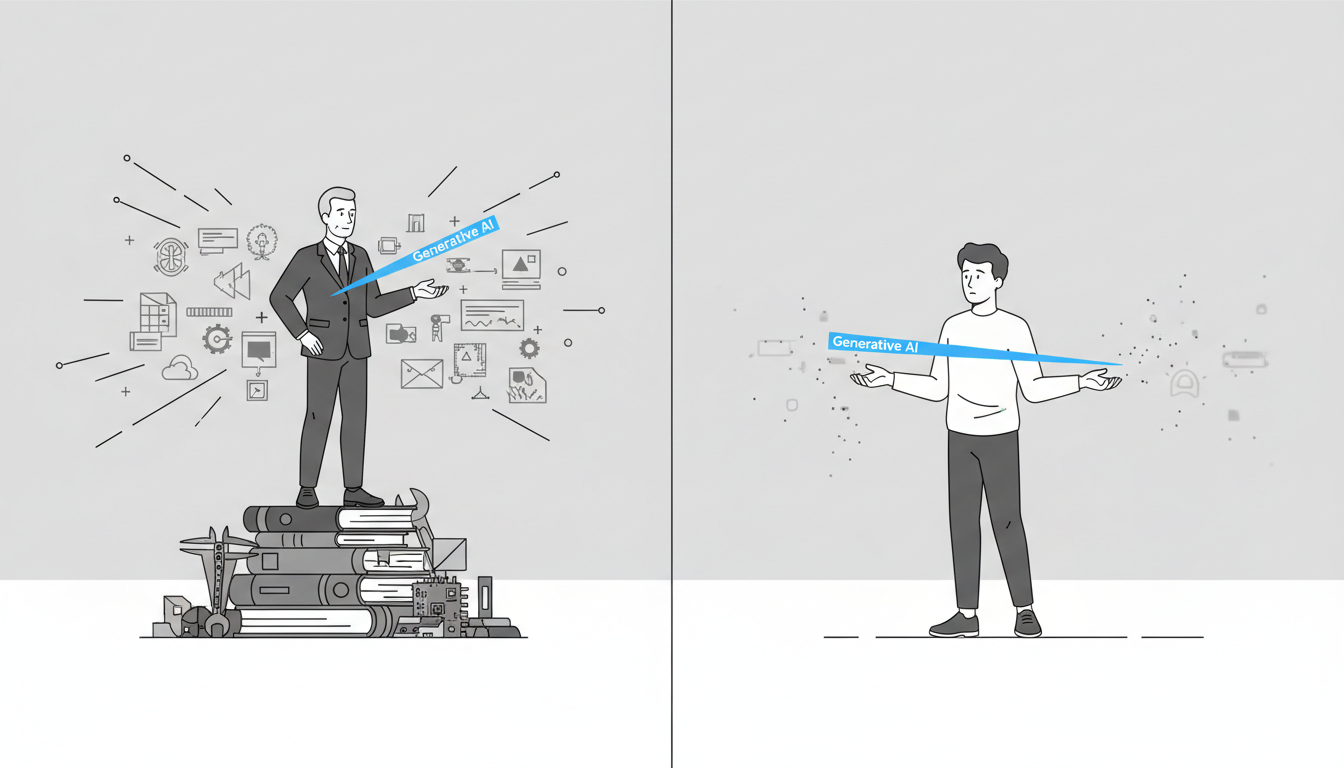
Early field experiments show that customer-support agents, junior writers and novice coders see productivity jumps of +34 % to +57 % once GenAI is embedded, while senior experts gain little unless the work is truly complex. That reverses the traditional experience curve: entry-level talent suddenly outperforms mid-tier staff, and veterans risk status loss.
GenAI threatens workers’ basic needs for competence, autonomy and relatedness, triggering five distinct coping strategies—direct resolution, symbolic self-completion, dissociation, escapism and fluid compensation. Only the first two improve performance; the others quietly erode engagement and increase turnover risk.
Humans are “extended minds” that constantly offload thinking to external resources; GenAI simply makes that hybridization explicit. The next competitive frontier is teaching staff when to trust, question or reject AI suggestions.
Sources:
Extending Minds with Generative AI (Nature Communications)
GenAI and the psychology of work (Trends in Cognitive Sciences)
Top News
1. Anthropic has launched Claude Opus 4 and Claude Sonnet 4. Claude Opus 4 can autonomously perform complex multi-hour tasks.
2. Google unveiled Deep Think, an enhanced reasoning mode for Gemini 2.5 Pro, as well as new AI-powered features for Gmail, Docs, and Vids.
3. Mistral introduced Devstral, a high-performance coding-focused model.
4. Microsoft envisions the Internet to be an open agentic web, where AI agents make decisions and perform tasks on behalf of users or organizations. The company also launched Microsoft Discovery, an enterprise-grade AI platform for R&D.
Additional Insights
1. Large language models show both individual and collective creativity comparable to humans (Thinking Skills and Creativity)
A recent study evaluating five large language models (LLMs), including GPT-4 and Claude, found that LLMs demonstrate creativity levels comparable to humans across a variety of tasks. On average, top models ranked in the 52nd percentile against human participants, excelling in divergent thinking and problem-solving but trailing in creative writing. Notably, the collective output from ten LLM responses was as creative as that from 8–10 human individuals, and every two additional LLM responses matched the creativity of one more human. Despite efficiency and scalability advantages, LLM-generated ideas were less diverse than human-generated ones, suggesting a homogenization effect.
2. On the conversational persuasiveness of GPT-4 (Nature Human Behaviour)
A recent study found that GPT-4, when provided with basic personal information, significantly outperforms humans in persuasive conversations, increasing the odds of shifting a person’s opinion by over 80%. This personalized persuasion was notably more effective than either non-personalized GPT-4 or personalized human arguments, highlighting the model’s ability to exploit minimal demographic data far more effectively than human counterparts. Despite GPT-4’s superior logical and analytical communication style, participants often perceived its arguments as more compelling, especially when unaware they were interacting with an AI. These results raise serious implications for AI-driven microtargeting and its potential misuse in political propaganda, misinformation, or manipulative marketing. Executives overseeing digital platforms and communication technologies should consider proactive governance measures to mitigate risks and explore responsible deployment of AI in persuasive contexts.
3. Welcome to the AI trough of disillusionment (The Economist)
Excitement around generative AI has given way to widespread frustration among businesses, many of which are struggling to implement the technology effectively due to legacy IT systems, talent shortages, and concerns over brand safety. Nearly half of generative AI pilot projects are now being abandoned, highlighting a stark gap between AI’s promise and its practical utility in corporate settings. Meanwhile, consumer adoption remains strong, and tech giants like Microsoft, Google, and Amazon continue to invest heavily, not just to sell AI services, but to integrate it deeply into their own operations. Despite minimal immediate returns, these firms remain optimistic, showcasing new capabilities and calling for broader experimentation, even as the industry navigates a “trough of disillusionment.” Experts predict this phase may last through next year, but those who persist may emerge into a more productive “slope of enlightenment,” while laggards risk falling behind.
4. Making AI Work: Leadership, Lab, and Crowd (One Useful Thing)
While AI is already delivering significant individual productivity gains, these are not translating into broader organizational performance due to a lack of systemic innovation. Capturing AI’s full potential requires a coordinated approach across Leadership, The Lab, and The Crowd: leaders must craft and communicate a clear vision of AI’s role, endorse experimentation, and provide incentives for transparent use; frontline employees need support and psychological safety to share and scale their successful AI workflows; and dedicated internal teams (The Lab) must rapidly test, benchmark, and deploy new AI-integrated processes. Current approaches relying on consultants and generic software playbooks are insufficient—organizations must actively create their own AI strategies tailored to their unique workflows and industry challenges. As AI rapidly evolves, the competitive edge will go to those who treat this as an organizational learning challenge, adapting structures, incentives, and norms to accelerate discovery and deployment.
Innovation Radar
1. AI Model Releases and Advancements
Anthropic has launched Claude Opus 4 and Claude Sonnet 4, powerful new AI models that set benchmarks in coding, reasoning, and agent capabilities, featuring extended tool use, improved memory, IDE integration, and advanced developer tools—all designed to enhance productivity and enable long-term, complex task execution. Claude Opus 4, can autonomously perform complex, multi-hour tasks by leveraging enhanced memory and decision-making capabilities, marking a significant step toward more independent and useful AI agents (MIT Technology Review).
At Google I/O 2025, Google unveiled major advancements across its AI ecosystem, including the launch of Deep Think, an “enhanced” reasoning mode for its flagship Gemini 2.5 Pro, the debut of immersive video platform Google Beam, the transformation of Project Astra into Gemini Live, the rollout of Agent Mode and personalized AI tools, and breakthroughs in generative media with Veo 3 and Imagen 4—marking a shift from research to widely accessible AI-driven experiences (Google).
AI startup Mistral has launched Devstral, a commercially licensed, high-performance coding-focused AI model developed with All Hands AI, designed for efficient local deployment and integration with code agent tools (TechCrunch).
2. AI Tools and Features
OpenAI introduced Codex, a cloud-based AI software engineering agent powered by codex-1 that can autonomously perform and verify coding tasks in parallel within secure environments, now available to ChatGPT Pro, Team, and Enterprise users, with broader access coming soon (OpenAI).
At Microsoft Build 2025, Microsoft unveiled major advancements in AI agent technology, including tools like GitHub Copilot’s new asynchronous coding agent, Azure and Windows AI Foundries, and Microsoft 365 Copilot Tuning, empowering developers and organizations to build, deploy, and orchestrate intelligent agents across platforms securely and efficiently. The company also adopts Model Context Protocol (MCP) and launched NLWeb to support the emerging “open agentic web,” where AI agents can interact directly with web content to perform complex, user-driven tasks (Microsoft).
Google is integrating its Gemini AI into Android XR-powered glasses and headsets to deliver hands-free, context-aware assistance and immersive experiences, while partnering with brands like Samsung, Gentle Monster, and Warby Parker to create stylish, practical wearables (Google). Stitch is a new Google Labs tool that transforms prompts and images into UI designs and front-end code, streamlining collaboration between designers and developers (Google). Google also announced new AI-powered features for Gmail, Docs, and Vids—including personalized smart replies, inbox cleanup, AI-assisted writing from trusted sources, video creation from slides, AI avatars, and enhanced editing tools—aimed at boosting productivity and content creation across Workspace (TechCrunch). Flow is a new AI-powered filmmaking tool from Google, designed for creatives to easily craft cinematic scenes using advanced models like Veo 3, Imagen, and Gemini, offering intuitive controls, asset management, and collaborative features to support innovative storytelling (Google).
OpenAI has significantly expanded the Responses API with support for remote MCP servers, new tools like image generation and Code Interpreter, enhanced file search, and enterprise-friendly features such as background mode, reasoning summaries, and encrypted reasoning, enabling developers to build more powerful, efficient, and intelligent agentic applications (OpenAI).
Apple plans to announce at WWDC that it will open its on-device AI models to third-party developers via an SDK, enabling broader integration of Apple Intelligence features into external apps (The Verge).
3. AI for Science and Medicine
Microsoft has launched Microsoft Discovery, an enterprise-grade AI platform that combines specialized agents, graph-based reasoning, and high-performance computing to transform the R&D process across industries by accelerating discovery, improving accuracy, and enabling scalable, responsible innovation (Microsoft).
FutureHouse has unveiled Robin, a multi-agent AI system that autonomously generated and validated a novel therapeutic candidate—ripasudil—for dry age-related macular degeneration, marking a breakthrough in fully automated scientific discovery (FutureHouse).
4. Other
Scientists have developed contact lenses infused with nanoparticles that allow humans to see infrared light—even with their eyes closed—by converting it into visible light, potentially enabling new applications in medicine and security despite current image clarity and sensitivity limitations (Nature).
A paper introduces the first real-time binaural hearable system—Spatial Speech Translation—that translates multiple simultaneous speakers in the user’s environment into the user’s native language while preserving each speaker’s spatial location and voice characteristics, enabling immersive and accurate multilingual communication in real-world settings (CHI2025).