
Highlights
Top Insights
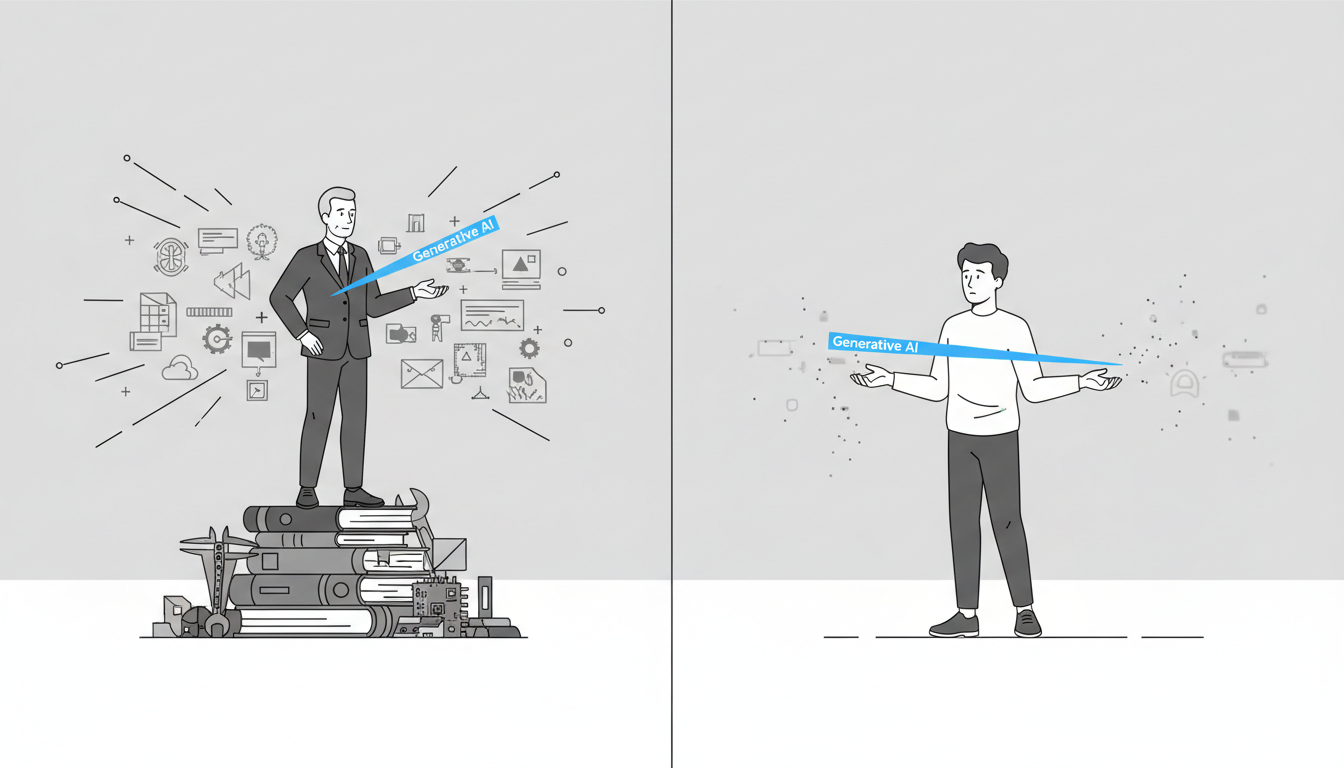
1. In a recent study of organizations, upgrading to a better AI model only explained 50% of performance gains: the other half came from how users changed their prompts to fit the new system.
2. When the system automatically rewrote users’ prompts, results dropped by 58%. The AI often added irrelevant details or altered the intent, leading to worse outputs. For business, this is a warning: automation that hides or overrides user intent can backfire. Transparency and user control matter as much as efficiency.
Source: Generative AI results depend on user prompts as much as models (Ideas Made to Matter)
Top News
1. Google has launched Deep Think, a reasoning feature in the Gemini app for Google AI Ultra subscribers.
2. Alibaba introduced new open-source AI image model, Qwen-Image.
3. OpenAI introduced GPT-5, as well as two open-weight language models, GPT-OSS-120B and GPT-OSS-20B.
4. Anthropic introduced Claude Opus 4.1, with stronger coding and enhanced research/data analysis.
Additional Insights
1. GPT-5: It Just Does Stuff (One Useful Thing)
GPT-5 represents a significant leap forward in AI, offering more autonomy and proactivity in problem-solving. Unlike previous models that required users to carefully select the appropriate AI and manage its task execution, GPT-5 automatically selects the best model and adapts its responses based on the complexity of the task. This makes it far more efficient and user-friendly, eliminating much of the trial and error users faced before. GPT-5 can handle a wide range of tasks, from generating startup ideas to building complex applications, all with minimal input and often adding unexpected features. While its ability to “just do stuff” is impressive, it still requires human oversight due to occasional errors and hallucinations. Overall, GPT-5’s blend of automation, creativity, and proactive task management is poised to change how we interact with AI, making it a tool that anticipates user needs and works independently to accomplish goals.
2. GPT-5 is here. Now what? (MIT Technology Review)
OpenAI’s GPT-5 marks a polished evolution of its AI lineup rather than a leap toward artificial general intelligence, merging standard and reasoning models so the system automatically decides how to handle queries. It offers faster reasoning, improved cost efficiency, reduced hallucinations, and subtle but noticeable user-experience upgrades, like more appealing outputs and less need for users to manage technical settings. While it tops several AI benchmarks, performance gains appear to be plateauing, and its coding score (74.9% on SWE-Bench) still falls short of impressive thresholds. Compared with last year’s o-series reasoning debut, GPT-5 feels more like a “Retina display” refinement—pleasant, efficient, and accessible to more users—but still a small step on the long road to AGI.
3. What scaling AI actually requires: 4 stages (Board of Innovation)
Scaling AI isn’t just about deploying a working proof-of-concept: it requires a deliberate, four-stage journey: Validate that the AI solves a high-priority business problem with meaningful ROI, Integrate it into real workflows and core systems with cross-functional alignment, Operationalize using modular, maintainable architecture that supports flexibility, monitoring, and compliance, and finally Scale with elastic infrastructure, CI/CD for AI components, drift detection, robust data pipelines, and organizational readiness. Most failures stem from neglecting non-technical factors like ownership, trust, and fit with daily operations. True scalability is baked in from the start through business alignment, workflow integration, modular design, governance, and reusability—turning AI from a lab experiment into a resilient, enterprise-wide capability.
Innovation Radar
1. AI Model Releases and Advancements
Google has launched Deep Think, a powerful new reasoning feature in the Gemini app for Google AI Ultra subscribers, offering advanced creative problem-solving and mathematical capabilities based on the award-winning Gemini 2.5 model (Google). Genie 3 is a real-time world model capable of generating highly interactive, dynamic environments that respond to user inputs and retain consistency over time, pushing the boundaries of AI-driven simulations for applications in agent training, research, and creative exploration (Google).
Qwen-Image is Alibaba’s powerful new open-source AI image generator that excels at rendering multilingual text (especially English and Chinese) within visuals, making it ideal for complex design tasks, though its real-world performance still trails some proprietary rivals (VentureBeat).
OpenAI announced GPT-OSS-120B and GPT-OSS-20B, open-weight language models optimized for reasoning, tool use, and efficient deployment, offering strong real-world performance, safety standards, and flexibility for developers to customize and run on various infrastructures (OpenAI). OpenAI’s GPT-5 is offering expert-level intelligence across coding, writing, health, and visual tasks, with enhanced reasoning and reliability, available to all users with additional capabilities for paid subscribers (OpenAI). Microsoft is integrating OpenAI’s GPT-5 into its consumer, developer, and enterprise products.
Claude Opus 4.1 enhances coding performance, real-world task handling, and reasoning, with improvements in precision, multi-file refactoring, and research skills (Anthropic).
ElevenLabs launches Eleven Music, an AI music service that allows users to create commercially cleared music, while facing legal challenges and opposition from the music industry (WSJ).
2. AI Tools and Features
Google DeepMind and Kaggle have launched Game Arena, an open-source platform that evaluates AI models through competitive strategic games—offering a dynamic, transparent, and scalable alternative to traditional benchmarks for measuring AI intelligence (Google).
ChatGPT is being optimized to help users make meaningful progress, learn, and solve problems efficiently, prioritizing real-world usefulness, healthy usage, and support during personal or emotional challenges, while continuously improving through expert guidance and user feedback (OpenAI).
Google is offering college students free access to its advanced AI tools, including a 12-month Google AI Pro plan, along with $1 billion in funding for AI education and job training programs (Google).
3. AI for Science and Medicine
Microsoft is pioneering a self-adaptive reasoning system, CLIO, which allows scientists to steer AI’s cognitive processes for scientific discovery, offering enhanced control, explainability, and performance without the need for post-training, demonstrating significant improvements in accuracy and uncertainty management (Microsoft).
4. Other
Brilliant Labs’ new $299 Halo smart glasses feature an AI agent and a memory system called Narrative that can recall names and past conversations, offer real-time contextual assistance, and even let users create custom apps with voice commands (The Verge).
China’s Zhejiang University has unveiled the “Darwin Monkey,” the world’s first brain-like supercomputer with over 2 billion artificial neurons and 100 billion synapses, designed to mimic a macaque brain and advance human brain-inspired AI and neuroscience research (SCMP).