Highlights
Top Insights
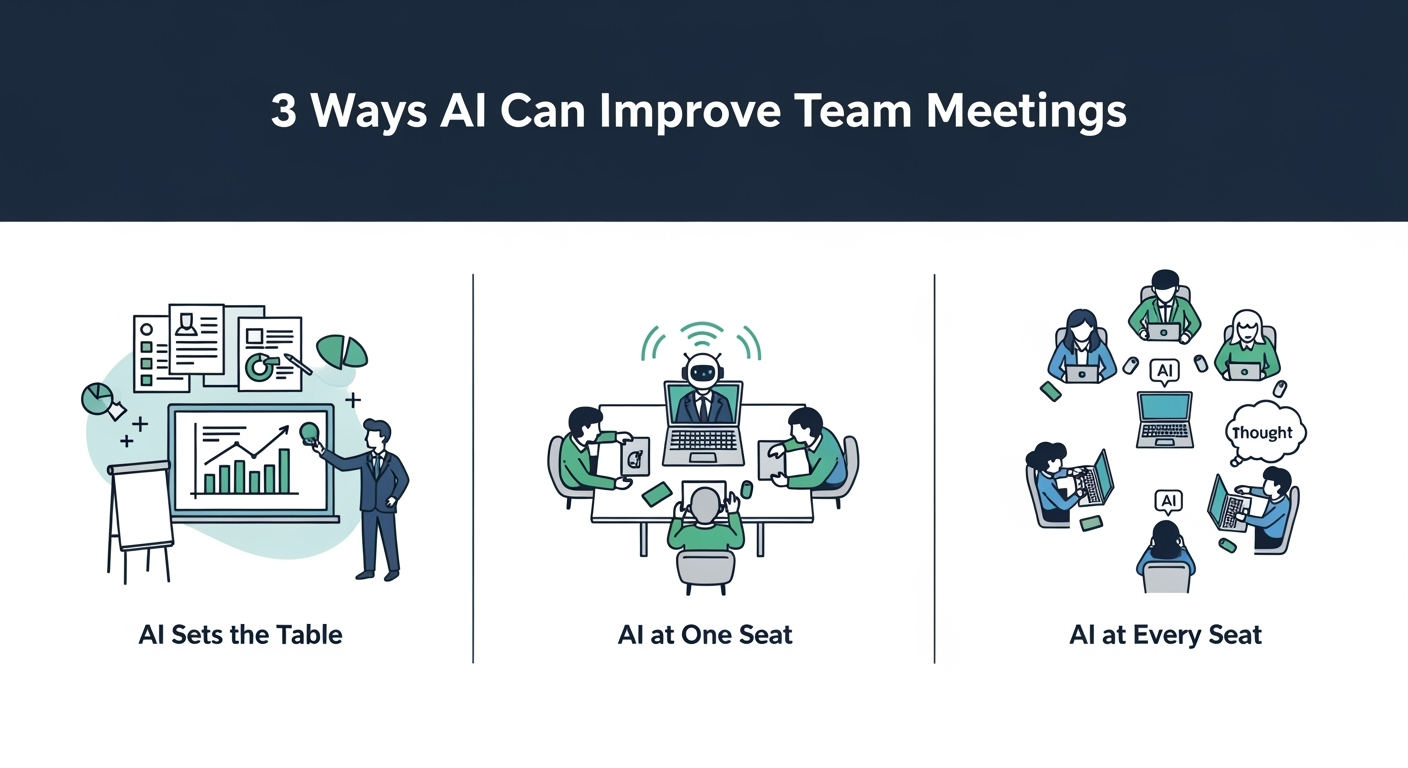
- Even AI-savvy teams often fail to use AI in collaborative settings (workshops, planning, strategy reviews), defaulting to pre-AI habits.
-
AI can be used to prepare for meetings, act an participant in meetings, and used at every seat to allow individual interactions.
-
Don’t let AI replace human facilitation, don’t let devices distract, and don’t experiment first with large groups.
Source: 3 Ways AI Can Improve Team Meetings (Harvard Business Review)
Top News
1. Google DeepMind revealed that the mysterious “nano banana” model is actually Gemini 2.5 Flash Image.
2. Tencent launched Hunyuan Video-Foley, an open-source AI system that generates lifelike, perfectly synced audio for videos.
3. Microsoft released VibeVoice-1.5B, an open-source text-to-speech model while OpenAI made its Realtime API generally available, introducing the advanced gpt-real-time speech-to-speech model.
4. Anthropic is piloting a Claude for Chrome extension that lets the AI take actions in the browser.
5. AI2 introduced an open-source ecosystem with agentic research assistant and developer tools for science.
Additional Insights
1. Beware the AI Experimentation Trap (Harvard Business Review)
Companies are misdirecting funds into flashy sales and marketing projects instead of deeper operational transformations, which historically generate higher ROI. While individuals see productivity gains from gen AI, organizations struggle to capture enterprise-level benefits because they treat AI as radical disruption rather than a tool to solve core customer problems. The authors warn against the “10,000 flowers bloom” approach to experimentation and argue that real value emerges only when AI initiatives are tightly linked to strategy, focused on high-intensity, frequent, and dense problems, and scaled by empowered “ninja teams.” The lesson: experimentation is vital, but without focus on customer value and scalable core transformations, companies risk repeating history by mistaking unfocused trials for meaningful progress.
2. Mind the gap: How operations leaders are pulling ahead using AI (McKinsey)
AI is driving faster returns in operations, leading organizations are pulling ahead by a wide margin, achieving nearly 4x the performance gains of slower adopters. Success stems less from experimenting with flashy tools and more from four factors: strong executive sponsorship to sustain projects through uncertain ROI periods, mature ecosystems of external and internal partnerships, cross-functional collaboration that bridges IT, operations, and business units, and disciplined investments in high-quality, accessible data. Case studies—from a retailer’s in-store chatbot to a pharmaceutical firm’s gen AI invoice checker—demonstrate tangible savings and efficiency gains, while failures highlight the need for leadership persistence and organizational alignment. Although payback times are shrinking across the board, the gap is widening between leaders that treat AI as a strategic, enterprise-level transformation and laggards struggling to scale pilots. The message is clear: catching up remains possible, but only with executive commitment, robust data infrastructure, and an operating model designed for AI at scale.
3. Mass Intelligence (One Useful Thing)
AI is entering a new era of Mass Intelligence, where powerful models once locked behind high costs and technical know-how are now cheap, accessible, and easy to use, reaching more than a billion people worldwide. The rollout of GPT-5 illustrates both the promise and confusion of this shift: by acting as a router across models, it lowered costs and gave more free users access to advanced Reasoners, though with inconsistent results at first. Efficiency gains have been staggering—running prompts is now cents instead of dollars, and energy use per request is lower than streaming seconds of Netflix—making it viable to provide cutting-edge AI at scale. At the same time, improvements in usability mean prompts no longer require elaborate hacks, and even casual users can generate complex text or manipulate images with simple instructions. The result is a flood of unpredictable outcomes: AI is saving lives, sparking businesses, enabling creativity, fueling deception, and reshaping relationships—all while institutions built for a world of scarce intelligence scramble to adapt. The surprise is not just that AI has gotten so powerful so quickly, but that it has become cheap and frictionless enough to put that power in the hands of nearly everyone at once.
4. Not Yet, Robots: How to Win in Media’s Flooded Era (Bain)
AI is flooding media with cheap, abundant content, but human creativity, proven intellectual property, and strong talent pipelines remain the key differentiators for success. While audiences are reluctant to fully embrace AI-generated works, they accept AI as a tool that can enhance human-led creativity, enabling both established companies and independent creators to produce higher-quality content at lower costs. Engagement is increasingly fragmented as consumers multitask across platforms, forcing companies to compete for attention and prepare for a future where AI agents may curate content better than platforms themselves. To stay competitive, media companies must balance efficiency gains from AI with investments in creative talent, leveraging franchises, trusted human-made content, and innovative monetization strategies like shoppable media, cobranded experiences, and hyperpersonalized offerings. Ultimately, in this “Flooded Era,” technology will reshape how content is made and distributed, but creativity and human-led storytelling will continue to cut through the noise.
Innovation Radar
1. AI Model Releases and Advancements
Nous Research released Hermes 4, an open-source family of large language models that rivals top proprietary AI systems in reasoning and math performance while removing most content restrictions (VentureBeat).
Baidu has launched MuseSteamer 2.0, a lower-cost image-to-video model with enhanced character coordination, lifelike audio, and multiple access options across its platforms (MSN).
Elon Musk’s xAI has open-sourced the weights for its older Grok 2.5 AI model on Hugging Face, with plans to release Grok 3 in six months (TechCrunch). Grok-code-fast-1 is a new lightweight, fast, and cost-efficient reasoning model purpose-built for agentic coding, offering strong performance across major programming languages, seamless tool use, and wide accessibility through launch partners like GitHub Copilot and Cursor (XAI).
Microsoft released VibeVoice-1.5B, an open-source MIT-licensed text-to-speech model capable of generating up to 90 minutes of expressive, multi-speaker (up to four voices) audio with support for cross-lingual narration and singing, marking a major advance in long-form, research-focused AI speech synthesis (MarkTechPost). Microsoft AI introduced MAI-Voice-1, a fast, expressive speech generation model, and MAI-1-preview, its first large in-house foundation model (Microsoft).
Google DeepMind revealed that the mysterious “nano banana” model, which topped LMArena, is actually Gemini 2.5 Flash Image—an upgraded AI editor that makes photo edits more consistent and realistic (Mashable). The model is also available in Adobe Firefly and Adobe Express.
Tencent’s Hunyuan lab has launched Hunyuan Video-Foley, an open-source AI system that generates lifelike, perfectly synced audio for videos by combining a massive video-audio-text dataset, advanced architecture, and professional-grade training methods to bring Foley-quality sound to AI-generated content (AI News).
2. AI Tools and Features
OpenAI has made its Realtime API generally available, introducing the advanced gpt-realtime speech-to-speech model with improved naturalness, reasoning, instruction-following, and function-calling, while adding support for remote MCP servers, image input, SIP phone calling, new voices, and lower pricing for production-ready voice agents (OpenAI).
Comet Plus is a $5 subscription that gives Perplexity users premium publisher content while ensuring fair compensation for journalists in the AI-driven internet (Perplexity).
Anthropic is piloting a Claude for Chrome extension that lets the AI take actions in the browser, while testing safety measures against prompt injection attacks (Anthropic).
Microsoft Copilot is now free on select Samsung TVs and monitors, bringing voice-powered AI and visual cards to make entertainment and everyday help more personal and social (Microsoft).
Google has expanded Google Vids with new AI-powered features like image-to-video, AI avatars, transcript trimming, and multi-format support (Google).
3. AI for Science and Medicine
OpenAI and Retro Biosciences used a specialized GPT-4b micro model to design new protein variants that achieved over a 50-fold increase in stem cell reprogramming efficiency and enhanced DNA repair, demonstrating AI’s potential to accelerate life sciences research and regenerative medicine (OpenAI).
Asta is an open-source ecosystem from AI2 that combines agentic research assistants, a rigorous benchmarking framework (AstaBench), and developer tools to accelerate science through trustworthy, transparent, and capable AI systems (AI2).
4. Other
Nvidia has launched its $3,499 Jetson AGX Thor “robot brain” developer kit, powered by its Blackwell GPU and capable of running advanced AI models, as part of its push to make robotics a major growth area beyond AI, despite the segment currently contributing only about 1% of its revenue (CNBC).