Highlights
Top Insights
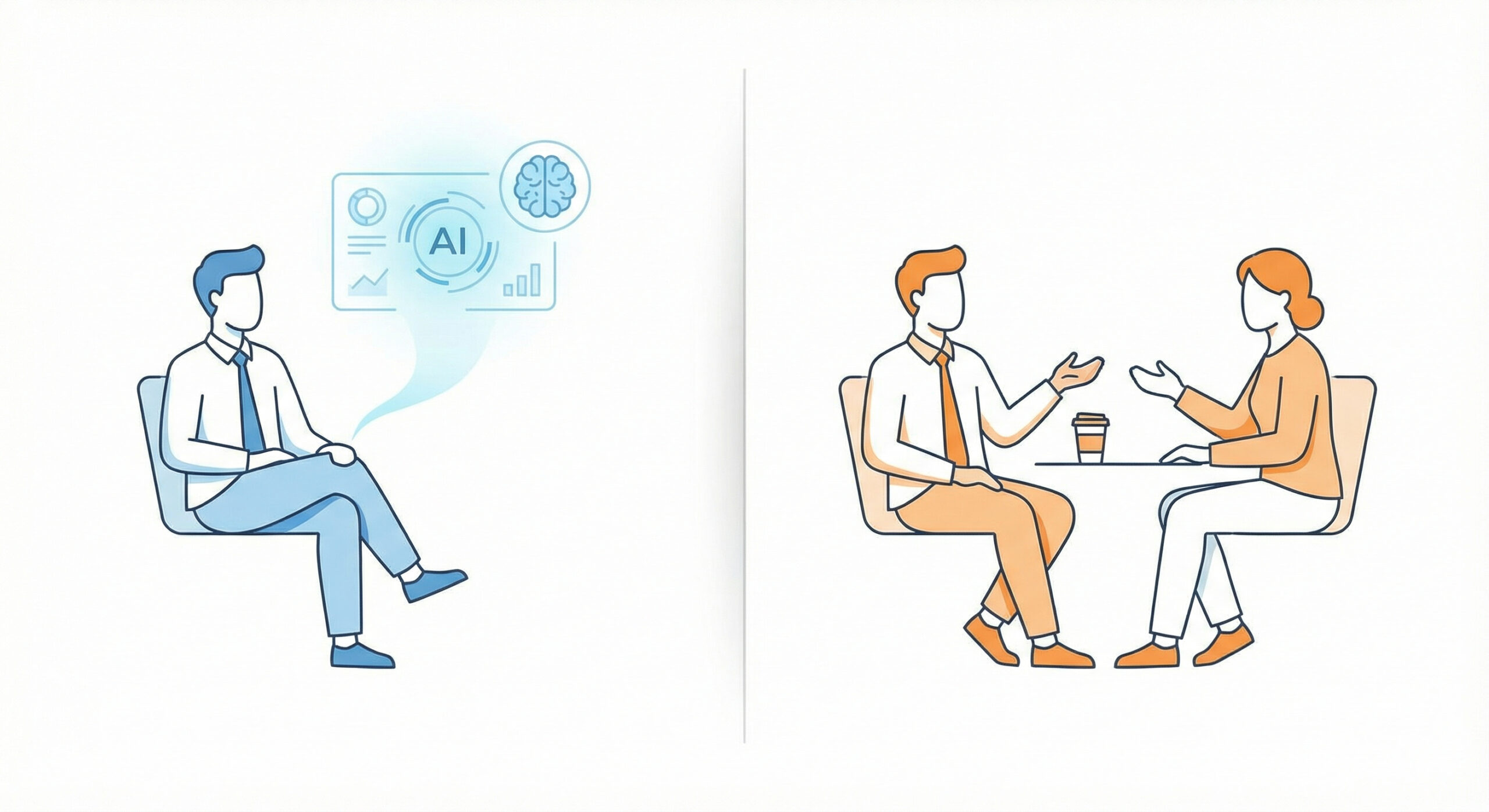
Leaders often make biased decisions without realizing it. In an experimental study, leaders with AI coaches got better at changing their thinking patterns much faster than those with human coaches.
AI-coached leaders showed bigger increases in activity in the prefrontal cortex (the part of the brain tied to reflection and self-control) suggesting the AI approach supported faster rewiring of bias habits.
AI coaching helps leaders unlearn bias faster by creating “algorithmic humility”: repeated, evidence-based nudges that make leaders more willing to question themselves.
Source: Algorithmic Humility in Leadership: Can AI Teach Leaders to Unlearn Bias Faster Than Human Coaching? (CMR Insights)
Top News
1. Grok 4.1 is an update that boosts Grok’s creativity, emotional intelligence, and overall capability.
2. Alphabet introduced Gemini 3, offering state-of-the-art reasoning, multimodal understanding, and powerful agentic capabilities.
3. Nano Banana Pro is Google’s new image-generation and editing model that delivers more accurate, text-friendly, high-fidelity visuals.
4. Major upgrades to Microsoft 365 Copilot were announced, including Work IQ intelligence, Office agents, and Agent 365.
5. Manus Browser Operator is a new extension that lets Manus automate tasks directly in a local browser.
Additional Insights
1. Mind-reading devices can now predict preconscious thoughts: is it time to worry? (Nature)
AI-enhanced brain-computer interfaces (BCIs) are rapidly improving, enabling devices to detect users’ intentions, even milliseconds before conscious awareness, and decode increasingly complex mental states, raising profound concerns about privacy, autonomy and AI influence over thought. As implanted BCIs expand beyond the motor cortex and consumer EEG devices grow more powerful but remain weakly regulated, ethicists warn that companies could infer sensitive information, manipulate behaviour or shape users’ identities through AI-mediated communication. Although the technology offers major medical benefits, experts argue that new safeguards (including stronger data protections and fiduciary duties for BCI developers) are urgently needed to ensure these systems act in users’ best interests rather than exploiting unprecedented access to their inner lives.
2. Three Years from GPT-3 to Gemini 3 (One Useful Thing)
In less than three years, AI has leapt from writing quirky poems to acting like a capable digital coworker, and Ethan Mollick’s tests of Gemini 3 reveal several surprising shifts: today’s models can autonomously build interactive apps, manipulate computers through agent frameworks like Antigravity, and execute multi-step plans with human-style check-ins, turning coding ability into broad digital capability. Most strikingly, Gemini 3 demonstrates emerging “PhD-level” judgment: it cleaned messy research files, generated original hypotheses, built novel measures, ran statistical analyses, and drafted a full academic paper—good, but imperfect, in the way a real grad student might be. The overall insight: AI has moved from chatbots to general-purpose agents capable of meaningful knowledge work, with humans increasingly acting not as editors fixing AI mistakes but as managers directing AI teammates.
3. Geothermal’s time has finally come (The Economist)
The article describes a fast-accelerating geothermal revolution driven by new drilling technologies, massive investment, and booming demand for round-the-clock clean power, especially from AI-hungry tech companies. Startups such as Fervo, backed by Google and valued at $1.4bn, are deploying enhanced geothermal systems (EGS) that use shale-industry drilling and fracking techniques to tap hot, impermeable rock across vast new areas, slashing drilling times and costs and enabling gigawatt-scale potential. Closed-loop systems (CLS) offer alternatives where water use or fracking is restricted, while early commercial projects in Germany and North America show rapid technical progress. Longer-term ambitions focus on superhot geothermal—8–20km-deep wells reaching supercritical temperatures that could yield terawatts of clean, always-on energy—though extreme conditions pose major engineering challenges. Breakthroughs from firms like Quaise and Mazama suggest these obstacles may soon fall, positioning geothermal as a major global clean-energy pillar by the 2030s and beyond.
4. Defining the Intelligent Enterprise (Bain)
Enterprise AI is shifting from isolated, single-agent tools to dense, collaborative networks of specialized agents that behave more like swarms or meshes than software workflows. “Vibe coding” is turning software creation into a conversational, real-time creative act that shifts the bottleneck from engineering capacity to idea quality. “Small AI” models, supercharged by distillation, test-time inference, and grounding in knowledge graphs, are emerging not as cost savers but as high-performance, trustworthy workhorses for complex domains. Underpinning all of this is the revelation that governance and identity for agents are no longer afterthoughts but foundational infrastructure, mirroring early cloud-era architectural shifts, signaling that intelligence itself is becoming a core operating layer of the modern enterprise.
5. Leading in the Age of AI Agents: Managing the Machines That Manage Themselves (BCG)
Agentic AI is revealing a management shakeup: although 35% of companies already use it and another 44% plan to, many still lack a clear strategy for a technology that behaves both like software and like a semi-autonomous colleague. This dual nature creates tensions (such as supervision vs. autonomy and retrofitting vs. reimagining processes) that traditional management models can’t resolve. Organizations gain far more value when they treat agentic AI not just as an efficiency tool but as a learning, evolving system that becomes more capable over time. To unlock this potential, companies must redesign workflows around agentic-first processes, overhaul governance, redefine roles for hybrid human-AI teams, maintain continuous learning for both people and agents, and anchor investments in long-term value rather than cost savings.
Innovation Radar
1. AI Model Releases and Advancements
Grok 4.1 is an update that boosts Grok’s creativity, emotional intelligence, and overall capability while sharply reducing hallucinations (xAI).
WeatherNext 2 is Google’s newest AI model that delivers much faster, higher-resolution, and more accurate global weather forecasts by generating hundreds of realistic scenarios from a single starting point (Google). Gemini 3 is offering state-of-the-art reasoning, multimodal understanding, and powerful agentic capabilities to help people learn, build, and plan anything across Google products (Google). Nano Banana Pro is Google’s new advanced image-generation and editing model that delivers more accurate, text-friendly, high-fidelity visuals with powerful creative controls and real-world reasoning (Google).
GPT-5.1-Codex-Max is a faster, more capable, long-horizon coding model that efficiently handles large, complex software tasks through multi-window reasoning and compaction, offering improved performance, lower cost, and enhanced safety for agentic coding workflows (OpenAI).
Poe has launched group chats that let up to 200 people collaborate with any of its 200+ AI models and custom bots in a single shared conversation across all devices (Poe).
SAM 3D introduces two state-of-the-art models for reconstructing objects, scenes, and human bodies from single images, making high-quality 3D understanding widely accessible for research, creative applications, and real-world products (Meta).
Ai2 has released fully open-source Olmo 3 models—with variants focused on chat, reasoning, and reinforcement learning (AI Business).
Quantum physicists at Multiverse Computing created a much smaller “DeepSeek R1 Slim” model that they claim performs nearly as well as the original while removing its built-in Chinese political censorship (MIT Tech Review).
2. AI Tools and Features
Google’s new AI-powered Search features help you quickly plan trips, find great travel deals, and turn plans into bookings with minimal effort (Google).
Microsoft Ignite 2025 announced major upgrades to Microsoft 365 Copilot (including new Work IQ intelligence, Office agents, expanded agent governance with Agent 365, and new tools for human-AI collaboration), all aimed at helping organizations become “Frontier Firms” powered by advanced AI assistants and agents (Microsoft). Microsoft Agent 365 is a unified control plane that lets organizations securely deploy, govern, and scale AI agents, across platforms and ecosystems, using the same identity, security, and management infrastructure already used for people and apps (Microsoft).
Manus Browser Operator is a new extension that lets Manus securely automate tasks directly in your local browser, combining cloud automation with your trusted local sessions for seamless access to authenticated tools and workflows (Manus).
Perplexity has relaunched its free, more conversational and personalized AI shopping assistant ahead of Black Friday, adding memory-driven recommendations, new product cards and PayPal-powered checkout (CNET).