


Highlights
Top Insights
1. AI labs are building systems that don’t just generate text or images, but simulate environments, physical and virtual, predicting what happens next in a situation.
2. There are at least three approaches being explored: video-based simulation (Google), full 3D spatial models (World Labs), and abstract predictive architectures (LeCun).
3. Some researchers (including OpenAI’s Ilya Sutskever) argue that LLMs already encode internal world models. Others disagree, arguing LLMs are sophisticated pattern matchers without grounded understanding .
4. World models are foundational for autonomous robotics in retail, manufacturing, logistics; self-driving systems; and AI copilots that make multi-step decisions.
Source: AI tools are being prepared for the physical world (The Economist)
Top News
1. Inception announced Mercury 2, the first diffusion-based reasoning language model.
2. Google has launched Nano Banana 2 (Gemini 3.1 Flash Image), a new state-of-the-art image generation model.
3. Anthropic announced major updates to Claude Enterprise’s Cowork platform, introducing enhanced admin controls, and early cross-app orchestration between Excel and PowerPoint.
4. Notion introduced Custom Agents, autonomous AI teammates that execute workflows across Notion and connected tools.
Additional Insights
1. Soft Power, Hard Results: What CEOs Should Look For in an AI-First Chief Transformation Officer (BCG)
Business transformations are inherently risky, with low success rates, and AI initiatives are even more challenging, as few companies are realizing meaningful bottom-line impact despite rising investment and CEO pressure. The article argues that appointing an AI-first chief transformation officer (CTrO) significantly improves the odds of success by centralizing accountability for execution and outcomes. An effective AI-first CTrO ensures AI is deployed where it creates measurable value, distinguishes real business results from superficial adoption metrics, and possesses enough technical fluency to bridge business and technology leaders. The role requires strong influence without formal authority, low ego paired with high accountability, and the ability to engage deeply in operations while maintaining an enterprise-wide perspective. CEOs are encouraged to assess their CTrO’s ability to drive sustained impact, focus on outcomes over visibility, navigate operational complexity, and ultimately embed AI capabilities so fully that the role becomes unnecessary.
2. AI is rewiring how the world’s best Go players think (MIT Technology Review)
AI has not simply made Go stronger or faster. It has shifted the game’s epistemology, moving authority from accumulated human heuristics to opaque machine priors, creating a strange era where professionals imitate strategies they cannot fully explain. Creativity has not disappeared but migrated from the opening, once a canvas of personal philosophy, to the middle game where memorization breaks down and judgment reemerges. The technology has flattened stylistic diversity at the top while simultaneously expanding access at the margins, narrowing gaps between elites and challengers and quietly eroding gender barriers by replacing exclusionary apprenticeship networks with algorithmic mentorship. Players now train less to invent and more to approximate a superhuman oracle, yet this imitation paradoxically sharpens humility, psychological resilience, and new forms of intuition shaped by pattern absorption rather than articulated principle. Go has entered an interpretive limbo where humans outperform past masters by deferring to systems they barely understand, and where meaning survives not in perfection but in the visible struggle, error, and narrative tension that only human competition can provide.
3. Look for New Ways to Create Value When Deploying Gen AI (HBR)
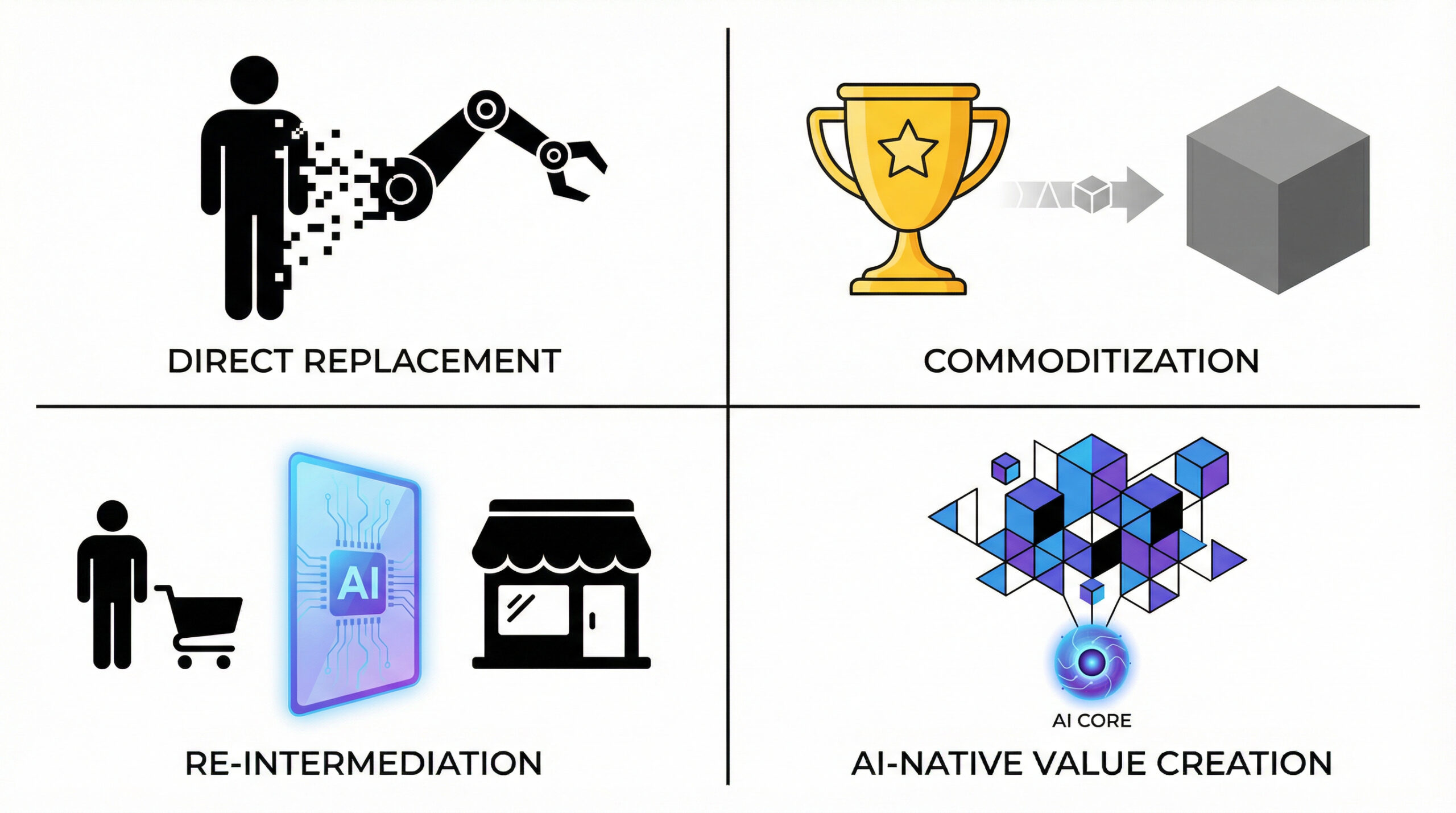
Generative AI driven productivity gains are not translating into higher margins because they are rapidly competed away, especially in sectors with the highest automation potential. This suggests that optimization is quickly becoming table stakes and that value does not disappear when bottlenecks are removed but instead shifts to new scarcities. The durable opportunities lie in identifying the frictions AI creates, such as verification, prioritization, and judgment in an environment of abundance, and building business models around solving those frictions. Another subtle shift is that firms should not seek safety in tasks AI cannot yet perform, since those value pools will likely shrink as capabilities advance. Instead, advantage comes from redeploying distinctive assets into new AI enabled offerings, repositioning for agent mediated markets, and even monetizing proprietary data or validation capabilities as infrastructure for the broader AI ecosystem.
4. AI’s Big Payoff is Coordination, Not Automation (HBR)
AI’s greatest economic impact lies in reducing “translation” costs—the effort required to turn one team’s outputs into another’s inputs—thereby enabling coordination across fragmented systems without forcing consensus on standards or tools . The author explains that AI can extract structure from unstructured data across emails, PDFs, software systems, and images to create a unified, real-time view of work, as illustrated in industries like construction and auto insurance where startups are bypassing entrenched standards by translating across them . This shift weakens incumbents that rely on proprietary standards and creates new competitive dynamics centered on who controls the translation layer . Firms can respond by becoming the neutral translation layer, doubling down on accountability and integrated execution, or internalizing translation while rationing ecosystem access . Ultimately, while AI-driven coordination can unlock speed and innovation, sustainable advantage will also require governance, trust, and clear accountability as ecosystems scale .
5. When AI Joins the Product Team, Will Leadership Still Drive Innovation? (California Management Review Insights)
Even as AI becomes deeply embedded in product teams and accelerates innovation by generating ideas and automating routine tasks, human leadership remains the true driver of strategic innovation because executives define ambitions, make trade-offs, and take responsibility for outcomes. AI can boost creativity and speed: for example, studies showing AI-assisted teams produce higher-quality ideas faster, but machines do not set goals or bear consequences. Leaders must therefore guide AI efforts with clear strategy, ownership, and accountability, or AI initiatives risk stalling or becoming fragmented. Effective AI adoption requires structured processes where leaders evaluate pilots against business outcomes and embed humans in decision loops. Ultimately, while AI expands a team’s creative and execution capacity, it does not replace the human judgment and leadership needed to choose which innovations to pursue and how to scale them.



Leave a Reply