Highlights
Top Insights
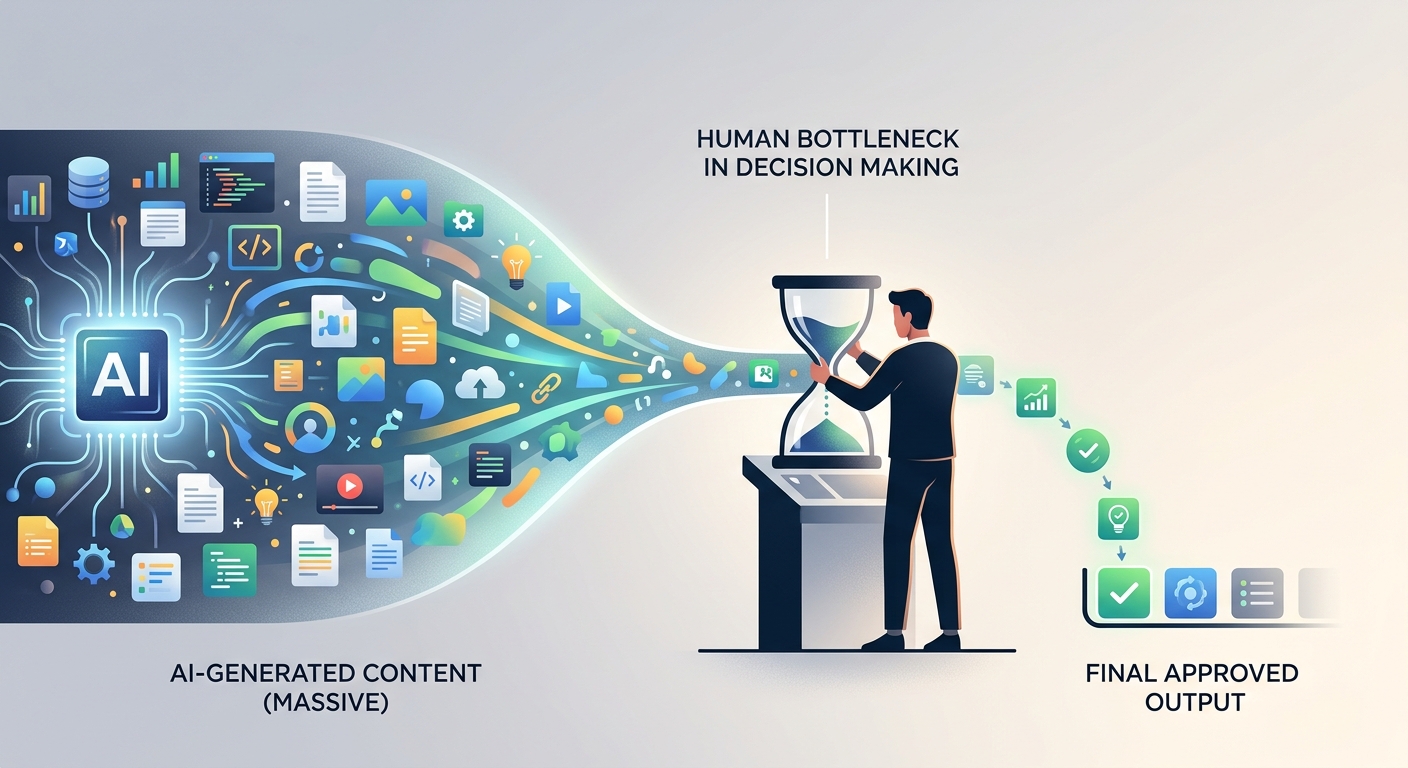
An AI investment can deliver impressive task-level ROI while leaving organizational profitability or service capacity relatively unchanged.
As AI becomes faster, the scarce resource may increasingly be experienced professionals capable of validating its output. Businesses could automate production while inadvertently creating a shortage of review capacity.
Companies could achieve short-term labor efficiencies while gradually eroding the human expertise required to supervise AI in the future. This is particularly consequential for consulting, law, accounting, engineering, and other apprenticeship-driven professions.
Source: The Hidden Costs of Delegating to AI (HBR)
Top News
1. Google DeepMind released Gemini 4 Hydrogen, a model adapted from Gemini 4 Carbon for fast coding, multimodal knowledge work,.
2. Alibaba Cloud opened a time-limited preview of Qwen4 Max, its next-generation flagship multimodal model.
3. ByteDance introduced Seedream 5.5 with a focus on professional image production.
4. Anthropic released Claude Fable 5.2 for general technical work and Claude Mythos 5.2 for vetted cybersecurity and biomedical organizations.
5. OpenAI introduced Businesses in ChatGPT, allowing eligible organizations to claim a verified profile and update business information.
6. Anthropic launched Claude Meetings, Claude Whiteboards, and Claude Sheets.
Additional Insights
1. Welcome to the B2A Economy (a16z)
AI is ushering in a new Business-to-Agent (B2A) economy, where autonomous AI agents, rather than humans, increasingly discover, evaluate, purchase, and interact with products and services. Just as the internet and smartphones transformed business distribution, AI agents could become the next major gateway to customers, forcing companies to optimize for machine-driven interactions rather than traditional human browsing. Early evidence suggests this shift is accelerating: Shopify reported an 8x increase in AI-driven store traffic and nearly 13x growth in orders from AI-powered searches, while coding agents already initiate more than 40% of GitHub pull requests. The authors identify four major opportunities: AI agent platforms, entirely new agent-enabled businesses, existing companies that optimize for agent-driven discovery and transactions, and infrastructure supporting agent identity, payments, security, and communication. Emerging technologies such as plugins, connectors, and Model Context Protocol (MCP) integrations will allow agents to interact directly with services, bypassing conventional websites and interfaces.
2. What an AI Consultancy Should Deliver in the First 90 Days (Board of Innovation)
An AI consultancy should deliver a production-ready, measurable AI system within its first 90 days—not just a strategy, prototype, or roadmap. According to Board of Innovation, successful engagements should follow four phases: defining measurable success criteria and establishing a baseline using real business data (weeks 1–2), building a working solution (weeks 3–6), strengthening security, testing, and enterprise integration (weeks 7–10), and deploying the system with full knowledge transfer (weeks 11–13). The consultancy must ensure the client owns the code, infrastructure, and operational capabilities rather than becoming dependent on external vendors. ROI should be evaluated against business metrics such as cost reduction, processing time, or revenue improvement, with performance benchmarks established before development begins.
3. Reinventing business planning with agentic AI (McKinsey)
McKinsey argues that combining predictive machine learning with agentic AI can transform traditional sales and operations planning (S&OP) from a manual, monthly forecasting exercise into a continuous, intelligent, and responsive decision-making system. While machine learning improves forecast accuracy by incorporating external demand signals such as competitor pricing, freight costs, and consumer behavior, AI agents automate data gathering, anomaly detection, scenario analysis, reporting, and execution of approved decisions. The business impact can be substantial: A tire manufacturer improved forecast accuracy by up to 25 percentage points and achieved more than $12 million in annual operational savings, while a life sciences company reduced forecast errors by approximately 50% and planning labor hours by 83%. Better forecasting can also reduce excess inventory, release working capital, improve service levels, and optimize production and procurement decisions.
Innovation Radar
1. AI Model Releases and Advancements
- Google DeepMind released Gemini 4 Hydrogen, a model adapted from Gemini 4 Carbon for fast coding, multimodal knowledge work, and everyday agentic execution. (Google DeepMind)
- Google made Gemini 4 Carbon available to paying developers and enterprises after an earlier limited release to cybersecurity defenders. (Google)
- Anthropic released Claude Fable 5.2 for general technical work and Claude Mythos 5.2 for vetted cybersecurity and biomedical organizations, with both based on the same underlying model. (Anthropic)
- Alibaba Cloud opened a time-limited preview of Qwen4 Max, its next-generation flagship multimodal model for text generation, image and video understanding, deep reasoning, coding, and complex agent tasks. (Alibaba Cloud)
- Baidu introduced ERNIE 5.5 Flash Preview alongside ERNIE Wizshot Micro-Expression and ERNIE Light Deep Thinking at Baidu World 2026. (Baidu via PR Newswire)
- China-based MiniMax released H3 Image, an open-weight model for text-to-image generation, reference-based generation, and image editing. (MiniMax)
- ByteDance introduced Seedream 5.5 with a focus on professional image production, precise edits, and preservation of unedited regions at the pixel level. (ByteDance Seed)
- ElevenLabs released Scribe v3 for recorded audio and Scribe v3 Live for real-time speech recognition across 102 languages. (ElevenLabs)
2. AI Tools and Features
- At Adobe MAX, Adobe added AI-assisted editing and generative controls across Photoshop, Premiere, Lightroom, Illustrator, InDesign, After Effects, Frame.io, and Firefly. (Adobe)
- OpenAI introduced Businesses in ChatGPT, allowing eligible organizations to claim a verified profile, update business information, upload product feeds, and review aggregated discovery insights. (OpenAI)
- Anthropic launched Claude Meetings, Claude Whiteboards, and Claude Sheets as part of a broader workplace-productivity push. (TechCrunch)
- Databricks introduced a second generation of Genie that can run long-lived jobs, delegate to subagents, monitor triggers, and notify people when a decision is required. (Databricks)
- Google expanded Gemini Intelligence to Pixel 10 devices and added features that turn spoken thoughts into polished text, complete multi-step tasks, surface proactive suggestions, summarize long conversations, and generate custom widgets. (Google)
- ElevenLabs previewed Interaction Engine, an orchestration layer that manages conversational turn-taking, interruptions, and selection of the language model used for each part of an exchange. (ElevenLabs)
3. AI Trends
- Vercel reported that more than half of October language-model requests on its AI Gateway went to models less than 60 days old. (Vercel)
- Vercel found that decision models reached 26 percent of requests on its gateway within six weeks while accounting for only 0.53 percent of spend. (Vercel)
- Kyndryl reported that 64 percent of surveyed leaders see positive returns on AI investments, up 10 percentage points from 2025. (Kyndryl)
- A VentureBeat survey found that 38 percent of respondents had delayed, reduced, or canceled an AI project because it cost more than expected, compared with 12 percent who cited insufficient computing capacity. (VentureBeat)
- Axios reported that widespread individual AI use has not consistently translated into organization-wide productivity improvements. (Axios)
4. AI for science
- Google DeepMind announced AlphaGenome 2, a DNA sequence model that predicts how genetic variants affect hundreds of specific human cell types and states. (Google DeepMind)
- Google DeepMind introduced AlphaProof Code, an agentic framework that combines human expertise with AI agents to produce mathematical proofs about real software. (Google DeepMind)
- Google DeepMind released Gemini Robotics 2.5, a vision-language-action model tested across more than 200 manipulation tasks. (Google DeepMind)
- MIT researchers reported a human-in-the-loop AI method for inverse design of high-performance engineering structures. (Communications Engineering)
- Researchers used 1,017 toxicity assays and 24 geospatial predictors to build high-resolution global maps of ecological risk from pharmaceutical mixtures in rivers. (Nature Geoscience)
- A Nature Communications study analyzed patient-specific diffusion MRI, individualized stimulation models, and 24 weeks of clinical assessments from 51 people receiving deep brain stimulation for treatment-resistant depression. (Nature Communications)
5. Others
- A UCL-led team developed an iodine chemistry that increases the energy-storage capacity of aqueous batteries, which use water-based electrolytes and avoid some fire and material risks associated with lithium-ion systems. (UCL)
- QuantumScape announced Osprey, an open development platform for all-solid-state lithium-metal batteries that the company intends to offer through licensing and co-development arrangements. (QuantumScape)
- Researchers created atomically dispersed ruthenium-oxygen-chromium motifs that damp oxidation during the acidic oxygen-evolution reaction used in proton-exchange-membrane water electrolysis. (Nature Materials)
- Researchers developed durable hydrogel ion channels that harvest energy from salinity differences and operate as self-powered environmental sensors. (Nature Sustainability)
- Researchers proved an unconditional advantage for constant-depth quantum circuits over comparable shallow classical circuits on a distribution-learning problem. (npj Quantum Information)
- MIT Lincoln Laboratory transferred a quantum diamond vector magnetic sensor toward industrial deployment with Frequency Electronics and the U.S. Defense Innovation Unit. (MIT Lincoln Laboratory)
- Researchers published LuCaS Plus, a multicenter atlas containing more than 2.5 million nuclei from 454 clinically annotated patients with non-small-cell lung cancer. (Nature Cancer)






Leave a Reply