
Highlights
Top Insights
The most consequential “singularity” may not be a moment when software AI surpasses human intelligence, but when physical AI (robots and autonomous machines) can rapidly expand industrial output with ever less human labor.
If capable robots begin building factories, infrastructure and even more robots, it would create a self-reinforcing cycle of expanding productive capacity: a physical analogue of recursive AI improvement.
Source: There’s a physical version of the AI singularity, and it matters a lot (The Economist)
Top News
1. OpenAI released GPT 6.1 Sol for complex coding and professional work.
2. Anthropic launched Claude Sonnet 5.5 across major clouds.
3. Google announced Gemini 4 Argon for long-horizon coding.
4. OpenAI launched Dots, persistent GPT 6 Astra-powered agents with their own cloud computers.
5. Meta introduced Muse for Small Business, an ongoing-goal agent connected to common finance, commerce and collaboration tools.
Additional Insights
1. Choosing the Right AI Experience for Employee Productivity and Support (Microsoft Inside Track)
Microsoft’s main lesson is that employee AI should be designed around intent rather than trying to make one assistant handle everything: Microsoft 365 Copilot Chat is positioned for broad productivity tasks such as summarizing meetings, researching, drafting, and reasoning across files, email, Teams, and the web, while the Employee Self-Service Agent is designed for authoritative workplace support across HR, IT, and facilities, using tightly controlled company sources and the ability to complete service workflows or escalate to support. Microsoft argues that effective enterprise AI depends on matching each experience to the right data, permissions, context, and actions; using only the personalization signals necessary for the task; placing specialized agents where employees already work; and continuously improving knowledge, routing, and workflows using employee feedback. The broader takeaway is that organizations should give each AI tool a clearly defined job, prioritize breadth for productivity but authority and actionability for support, and make it simple for employees to know which experience to use.
2. The Formula for Agentic AI Value (Boston Consulting Group)
BCG’s 2026 Applied AI Index argues that enterprise AI is beginning to deliver measurable business value, but the strongest results come from combining strategic clarity with applied AI rather than simply spending more: companies strong on both dimensions report about 5× more AI value, while the most mature 7.5% show 2.4× the top-line growth of less mature peers. Based on a survey of more than 1,300 senior leaders across 20+ sectors, BCG finds that nearly half of companies now generate value from AI and that spending has risen to roughly 3.3% of revenue, with 80% occurring outside IT. The next major opportunity is agentic AI: its share of AI value has risen from 17% to 22% and BCG projects it could reach 39% by 2030, yet only 5% of companies currently have the full governance controls needed for increasingly autonomous agents. Leading companies concentrate investment on a few high-value end-to-end workflows, give the C-suite accountability, measure results through KPIs or P&L impact, redesign roles around collaboration between humans and agents, and build common enterprise AI/data platforms. The broader message is that AI transformation is primarily an organizational transformation, reflected in BCG’s “10-20-70” model: roughly 10% of effort on algorithms, 20% on technology and data, and 70% on people, processes, and organizational change.
3. What real insights feel like, and other notes from a design legend (IDEO)
IDEO design pioneer Jane Fulton Suri argues that genuine insight is not simply a research finding but a “change of state” in understanding—a moment that makes you see a problem differently. Her approach emphasizes getting away from screens, observing people and environments directly, and remaining open to unexpected clues outside formal research plans; one example is a designer realizing, from a Russian department store’s straightforward display of rows of black shoes, that transparency could be central to building trust in a new banking experience. Suri sees design research less as detached observation and more as collaborative “co-discovery,” where researchers, clients, and participants explore together. She also stresses that useful research need not be expensive, that designers sometimes need conviction to propose ideas before evidence is complete, and that communicating insights may require experiential formats rather than conventional presentations. More broadly, she extends human-centered design toward “life-centered design,” applying the same curiosity and observation to natural and living systems in search of more sustainable solutions.
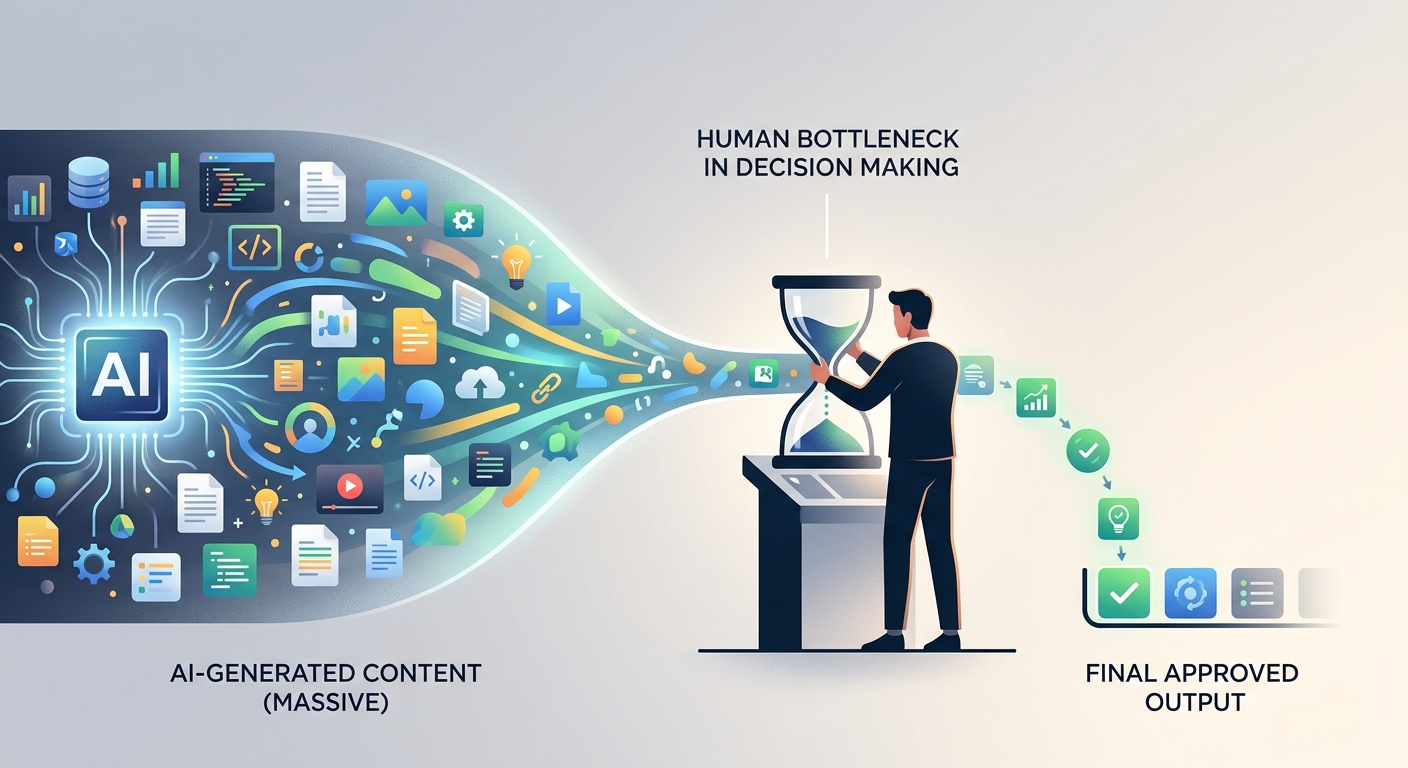
4. AI Is Making Verification the Bottleneck for Companies (HBR)
Christian Catalini argues that as AI makes generating text, code, analysis, and decisions increasingly cheap, the real organizational bottleneck—and source of competitive advantage—shifts to verification: determining whether AI output is correct, relevant, trustworthy, and worth acting on. Firms become effective “verification factories” when they combine proprietary ground truth with experienced experts who can detect errors, surface tacit knowledge, and challenge seemingly plausible outputs; the page 6 framework shows that AI is safest where both automation and verification are cheap, while risk rises sharply when AI can generate cheaply but expert verification remains costly. Catalini warns that companies can undermine this advantage by automating experts out of the loop, compressing disagreements into premature consensus, or allowing outside AI providers to capture the operational traces of corrections, overrides, and exceptions that encode how the firm actually makes judgments. Instead, companies should build learning loops that record AI decisions and human overrides, test both against real-world outcomes, preserve divergent expert views, use company “world models” as supporting infrastructure rather than autonomous decision-makers, and retain control over the data, feedback, and improvements produced by these systems—potentially through open-weight models or carefully structured partnerships. His central strategic message is that the most valuable AI asset may not be the model itself, but the proprietary system for learning when the model is wrong and why.
5. The CEO’s singular impact on the success—or failure—of AI in organizations (McKinsey)
McKinsey argues that the biggest determinant of whether AI produces enterprise-level value is not the technology itself but CEO leadership: although 89% of organizations report using AI in at least one function, only about 6% qualify as “high performers” that attribute at least 5% of EBIT to AI. The article says CEOs cannot delegate three responsibilities: raise strategic ambition, rearchitect the organization, and reset the culture. Rather than spreading AI thinly across many pilots, CEOs should concentrate major investment on two or three business domains where AI can fundamentally redesign workflows and drive growth, while protecting proprietary data, decision logic, and organizational learning as sources of durable advantage. They must also redesign work around human–AI agent teams, shifting managers toward judgment, coaching, and exception handling while investing heavily in reskilling and role redesign. Finally, CEOs need to personally model AI adoption and create a learning-oriented culture built on experimentation, trust, accountability, and rapid feedback; McKinsey says active senior-leader engagement is the strongest predictor of successful AI implementation. The core message is that AI is not a conventional technology project with a finish line but an ongoing organizational “metamorphosis,” and the CEO’s unique role is to make the cross-enterprise strategic, organizational, and cultural choices that determine whether AI becomes a source of meaningful competitive advantage.
Innovation Radar