


Highlights
Top Insights
OpenAI claims its latest AI agents have solved at least 372 long-standing mathematics problems in a matter of weeks, producing more than 700 research papers. The significance is that AI may be crossing the boundary from assisting human experts to performing original intellectual work autonomously.
Only 127 of the 372 claimed solutions had accompanying computer-checkable verification. Experts may need years to fully assess the results. AI can potentially generate more knowledge than humans can practically validate or absorb.
The most valuable human capabilities may increasingly be problem framing, scientific judgment, connecting insights across disciplines and deciding which discoveries deserve investment.
Source: OpenAI claims to have solved hundreds of long-standing maths problems (The Economist)
Top News
1. Anthropic released Claude Haiku 5.5 for high-volume, latency-sensitive work
2. Mistral opened Mistral Large 4 for public preview, offering a one-trillion-parameter multimodal model.
3. Google Cloud announced a universal Gemini work agent that plans tasks, uses business context and tools, and returns completed work.
4. ChatGPT added audio-file uploads for transcription, summaries, questions, and follow-up drafting. OpenAI introduced visual ads for ChatGPT image-generation sessions.
5. Microsoft made Execution Containers generally available and detailed Windows routing between local and cloud AI.
Additional Insights
1. Which Strategic Foresight Approach Is Best for You (Boston Consulting Group)
BCG argues that effective strategic foresight is not about predicting the future or adopting the latest analytical tools, but about building capabilities tailored to an organization’s strategic objectives, investment horizons, and competitive environment. Drawing on research involving more than 500 organizations, the article identifies four distinct foresight approaches: Listeners, which use real-time customer and market data to optimize existing operations and respond rapidly to changing demand; Scouts, which identify emerging technologies, unmet customer needs, and disruptive growth opportunities; Visionaries, which monitor critical technological, regulatory, and market developments to determine when to commit to transformative innovations; and Navigators, which use scenario planning, simulations, and ecosystem analysis to manage complex, long-term capital investments. Organizations using an unsuitable approach were approximately 20 percentage points less likely to express confidence in their ability to anticipate and adapt to disruption. AI, advanced analytics, and digital twins can strengthen these capabilities, but technology alone is insufficient. Companies may need a combination of approaches across business units, adapting their mix as strategic priorities evolve. The central takeaway is that competitive advantage comes not simply from anticipating change, but from selecting the right foresight capabilities and systematically translating insights into timely strategic decisions and measurable business outcomes.
2. Want Employees to Embrace AI Stop Selling It as a Productivity Tool (Stanford Institute for Human Centered Artificial Intelligence)
Stanford research reveals that successful AI adoption depends less on productivity gains and more on how AI enhances employees’ work, skills, and sense of purpose. Studying AI deployments across a law firm, advertising agency, and IT services company, researchers found that positioning AI primarily as an efficiency tool can undermine motivation and discourage experimentation, whereas framing it as an opportunity to eliminate tedious tasks and pursue more meaningful responsibilities increases engagement. In a law firm study, paralegals whose managers emphasized job enrichment used AI 58% more frequently and experimented 70% more than colleagues whose managers focused on faster output. Crucially, successful adoption also required dedicated learning time, formal training, mentorship, and opportunities for knowledge sharing. The findings challenge traditional productivity metrics, emphasizing that organizations should measure the quality and strategic value of AI-enabled work rather than output volume or AI usage alone. The key takeaway for leaders is that AI transformation must be treated as a people-development initiative, not merely a technology rollout: organizations achieve greater adoption and business value when they invest in employee growth, redesign roles around higher-value activities, and reward meaningful contributions rather than simply expecting workers to produce more with fewer resources.
3. AI Is Changing Work Now It Has to Change the Organization (McKinsey and Company)
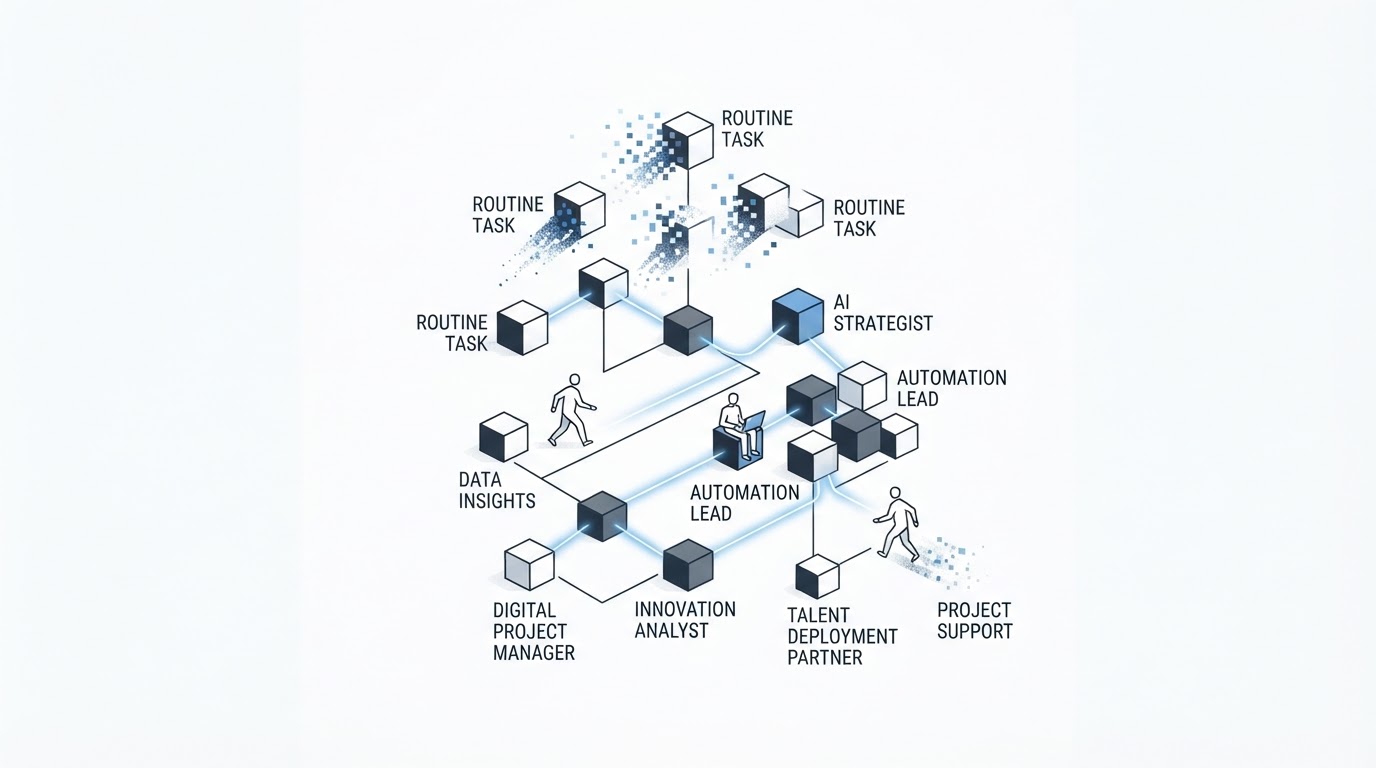
McKinsey argues that unlocking AI’s full business value requires fundamentally redesigning organizations rather than simply deploying AI tools to improve individual productivity. While 80% of surveyed respondents report productivity gains from AI, only 37% report a positive impact on operating profits, highlighting a significant gap between adoption and enterprise-wide value creation. To close this gap, McKinsey identifies four critical shifts: (1) redesign operating models around business outcomes, replacing rigid functional hierarchies with agile teams combining human expertise and AI agents; (2) reinvent talent management by emphasizing human judgment, adaptability, continuous learning, and new career pathways as AI automates traditional tasks; (3) embed organizational change through leadership commitment, employee trust, redesigned incentives, and continuous experimentation; and (4) establish a coordinated transformation engine, including dedicated cross-functional teams or “agentic mission factories” that systematically redesign workflows and scale AI solutions with appropriate governance. Importantly, AI should not merely eliminate tasks or reduce headcount but enable employees to focus on higher-value work while preserving opportunities to develop expertise.
4. What Top Performers Do Differently with AI and Why They See the Biggest Benefits (Harvard Business Review)
Generative AI is not necessarily leveling the playing field between high- and low-performing employees; instead, it may amplify existing performance differences by disproportionately benefiting top performers. While AI can help less experienced workers improve through automated guidance, templates, and coaching, high performers can use it to eliminate routine tasks and redirect their time toward higher-value activities, such as strategic thinking, customer relationships, and complex decision-making. In sales, where success depends on a combination of activities rather than isolated tasks, these advantages may compound and widen productivity gaps. The central takeaway is that AI’s greatest value comes not simply from adopting the technology, but from how effectively individuals and organizations redesign their workflows around it. Companies should therefore rethink how they train employees, structure teams, and integrate AI into everyday work to maximize performance gains.
Innovation Radar



Leave a Reply