

Highlights
Top Insights
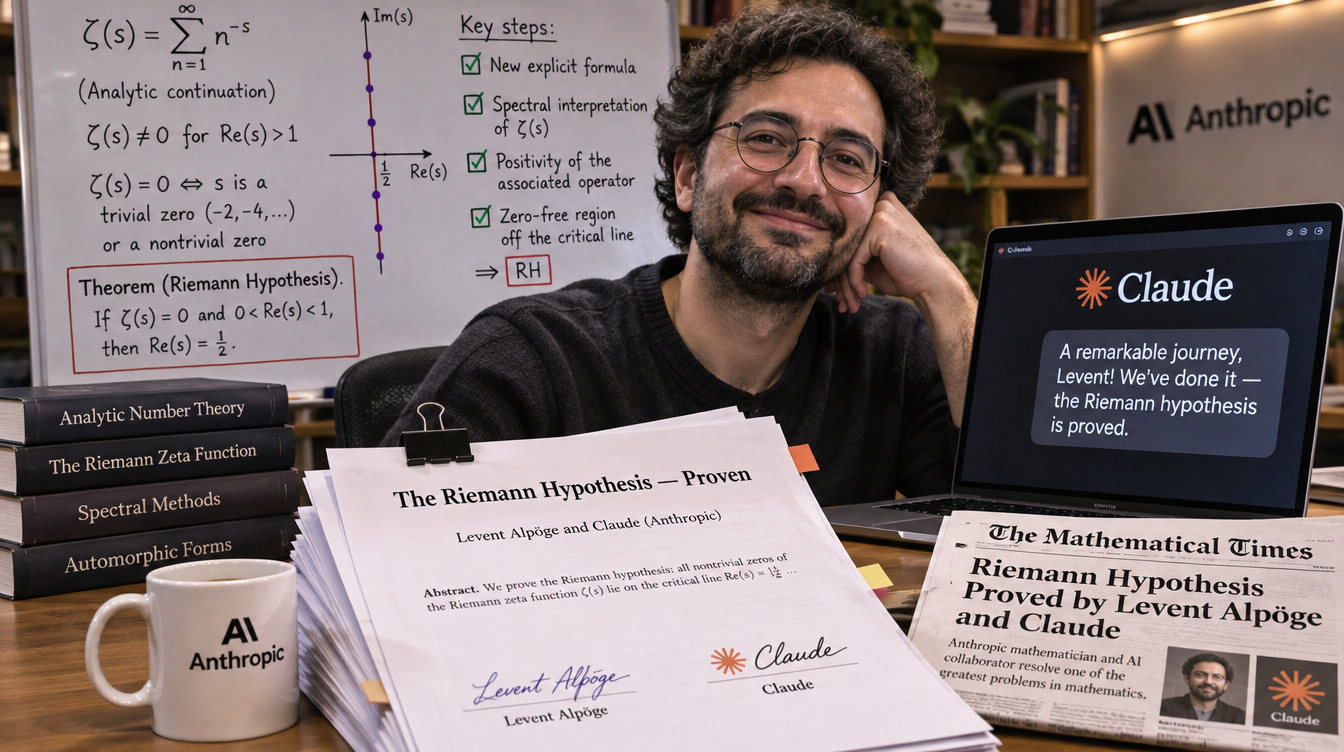
Anthropic mathematician Levent Alpöge, working with Claude, has allegedly proved the Riemann hypothesis, a foundational mathematical problem concerning the distribution of prime numbers that remained unsolved for 167 years.
While AI has demonstrated remarkable capabilities in constructing sophisticated proofs, whether it can develop genuinely novel mathematical theories remains unclear.
The achievement highlights an emerging distinction between proving mathematical truths and understanding why they are true, potentially shifting human researchers’ focus from problem-solving towards interpreting AI-generated discoveries and building conceptual frameworks.
Source: AI has conquered mathematics’ greatest challenge (The Economist)
Top News
1. Tencent researchers introduced the open-weight WeMM-Ecom family for e-commerce content understanding, search and catalog tasks.
2. Baidu released ERNIE 5.5 Flash Preview weights under Apache 2.0 after its earlier API launch.
3. Anthropic launched Claude Ship to review, fix and make policy-based approval decisions on GitHub code changes.
4. OpenAI began rolling out ChatGPT Space to eligible Plus subscribers, enabling collaborative interactive pages and presentations.
5. OpenAI reported laboratory binding results for protein designs generated using a pre-release GPT-6.2 model and supporting specialist tools.
Additional Insights
1. How Will AI Shake Up Your Growth Strategy?(BCG)
AI is fundamentally reshaping corporate growth opportunities and competitive advantages, creating both significant revenue potential and existential threats. BCG’s analysis of 3,669 public companies found that the proportion linking AI to growth initiatives increased from 4.9% in 2017–2022 to 12.7% in 2023–2025, with growth outperformers discussing AI in connection with growth nearly three times as frequently as underperformers. BCG identifies four strategic approaches based on AI-driven market opportunities and exposure to disruption: (1) Catch the wave by capturing emerging AI-related demand; (2) Reinvent the core by transforming existing offerings into AI-first products and services; (3) Pivot beyond the core by applying enduring competitive advantages to new markets where existing business models face commoditization; and (4) Step up your game by using AI to accelerate innovation, commercialization, and operational execution.
2. Three lessons from century-old companies on delivering AI transformation (WEF)
A World Economic Forum article highlights three lessons from long-established materials science companies: (1) Deploy AI in structured, rules-based environments – Henkel uses AI-powered simulations to predict formulation performance, enabling individual scientists to test more than 50 formulations weekly and increasing annual laboratory throughput sixfold. (2) Prioritize business problems over technology adoption – Stahl leverages AI to synthesize proprietary R&D data, identify promising research opportunities and maintain human oversight of strategic decisions while protecting intellectual property. (3) Redesign workflows, knowledge-sharing and employee incentives – AkzoNobel uses AI to connect 2,000 R&D professionals across 70 laboratories in more than 20 countries, reducing duplicated efforts and accelerating materials development from years to weeks, according to the article. The overarching takeaway is that sustainable AI transformation requires integrating technology with domain expertise, organizational culture, data governance and human-centric incentives, positioning AI as an enabler of scientific innovation and workforce productivity rather than simply a replacement for human labor.
3. Welcome to the B2A Economy: How Agents Buy (a16z)
The article explores how AI agents are emerging as a new distribution channel, fundamentally reshaping how businesses market and sell products. Based on 11,307 agent tests across 1,270 prompts and consumer spending data, the authors identify five strategies for succeeding in the business-to-agent (B2A) economy: differentiate products for specific use cases rather than competing for generic recommendations; optimize websites for agent readability and accessibility through APIs and MCP integrations; communicate total cost, product value, and customer protections transparently; tailor distribution strategies to individual agents’ distinct preferences; and establish a presence on marketplaces and aggregators where agents already transact. Agents prioritize economic value and trust, with 72% recommending a more expensive but trustworthy seller over a cheaper, less trusted alternative. Distribution infrastructure is equally important: marketplaces, aggregators, and multibrand retailers accounted for 55% of observed spending among the top 50 merchants, while mandatory account creation consistently disrupted checkout.
Innovation Radar





Leave a Reply