
Highlights
Top Insights
Firms overwhelmingly use AI to reduce labor, but that is often the least strategically valuable use of the technology.
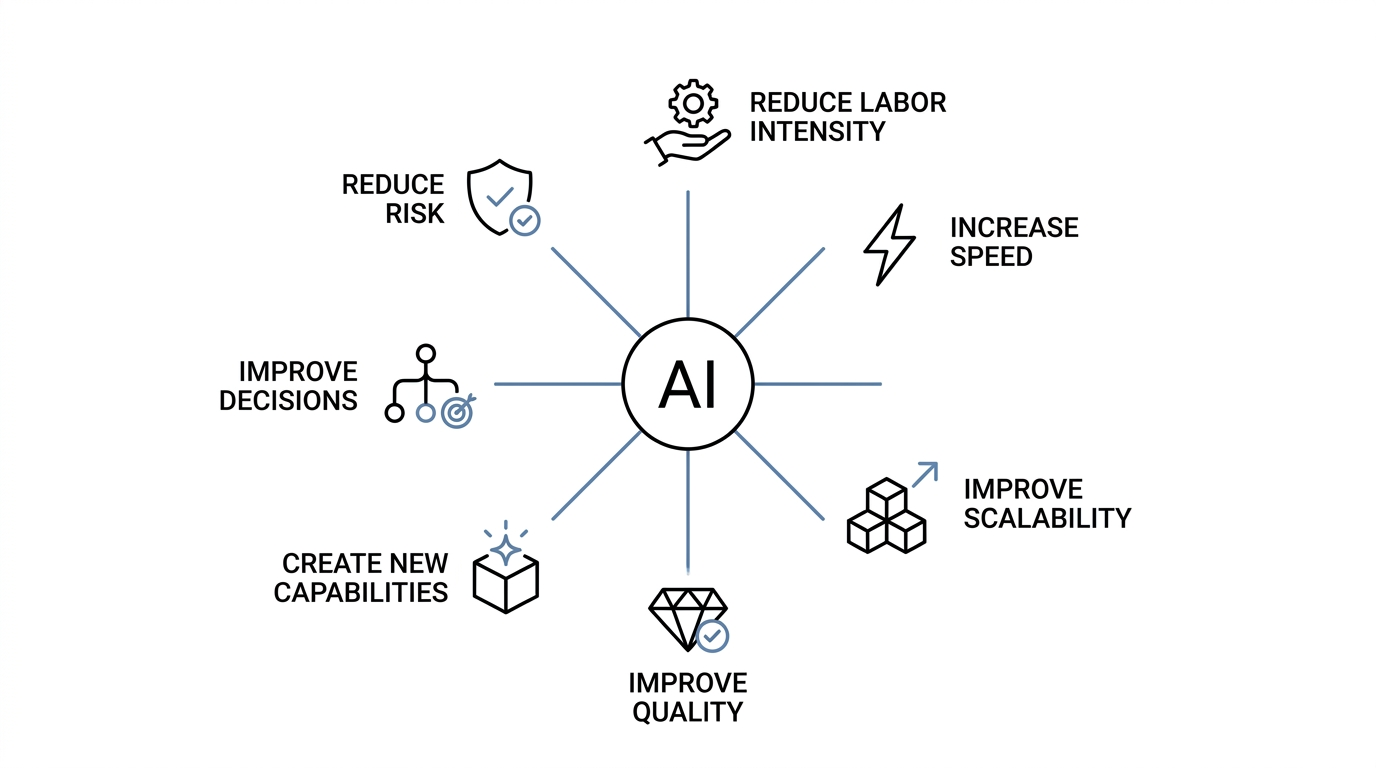
There are actually seven AI value levers:
Reduce labor intensity
Increase speed
Improve scalability
Improve quality
Create new capabilities
Improve decisions
Reduce risk
Organizations may be optimizing for the easiest benefit (cost savings) instead of the largest opportunity (growth).
There is research showing that companies historically earn stronger returns when technology enables:
new products
faster innovation
higher quality
market expansion
rather than simply lowering operating costs.
Source: The AI Value Levers: How Innovation-Focused Strategies Outperform—for Firms and Workers (Belfer Center)
Top News
1. OpenAI previewed GPT-5.6 Sol, plus Terra and Luna variants.
2. Anthropic introduced Claude Tag, a Slack-native way for teams to tag Claude in conversations.
3. Google Workspace added AI features for Drive, Sheets, and Gmail to organize files, analyze data, and improve emails.
4. Google added Gemini Enterprise governance features for registering agents and MCP servers and controlling agent egress.
5. OpenAI and Broadcom unveiled an LLM-optimized inference chip aimed at improving AI serving economics and performance.
Additional Insights
1. Agentic AI Turns Every Team into Its Own Transformation Engine (BCG)
Agentic AI fundamentally changes how organizations should approach transformation: instead of relying on centralized change programs, every team becomes responsible for redesigning its own workflows with AI. As generative and agentic AI adoption accelerates, the primary challenge is no longer deploying the technology but achieving high-quality adoption that delivers measurable business outcomes. The authors describe five structural shifts driving this new model: AI capabilities evolve too quickly for traditional transformation programs; innovation increasingly originates within teams; transformation scales through hundreds of parallel local improvements rather than a few enterprise initiatives; domain experts—not central transformation offices—must lead workflow redesign; and job roles are continuously reshaped as humans transition from executing tasks to orchestrating AI systems. The article emphasizes that organizations should focus team-led transformation on a small number of strategically important business domains rather than encouraging unfocused experimentation. Using AWS’s software development transformation as an example, BCG highlights that success came from changing engineering habits and measuring business impact (such as shipping 27% more features), not merely increasing AI tool adoption. The article concludes with an executive checklist advocating a people-first approach: align AI initiatives with strategic priorities, empower teams to redesign work, build new management and governance capabilities, invest in skills and behavioral change, and measure outcomes in terms of business value rather than technology deployment alone.
2. The 5 Types of AI Investment–and How to Capture Their Value (HBR)
Most organizations misjudge AI investments by evaluating them with traditional ROI metrics, when AI creates value through five distinct investment types that require different financial logic. Two are tactical: competitive parity, where AI is necessary simply to avoid falling behind competitors, and option value, where experimentation builds organizational AI fluency and future adaptability rather than immediate returns. Three are strategic: unique integration, where AI is embedded into proprietary workflows to strengthen existing competitive advantages; data flywheels and lock-in ecosystems, where operational data continuously improves AI and increases customer switching costs; and organizational capability building, where companies transform their workforce, culture, and decision-making processes to become more adaptable over the long term. Using examples such as Bank of America, Moderna, Amazon, John Deere, and Walmart, the author contends that the greatest value from AI comes not from the technology itself but from how it is uniquely integrated into an organization’s processes, data, and capabilities. Leaders should therefore classify AI initiatives by these five categories, measure each using metrics appropriate to its purpose rather than standard ROI, and shift more investment toward the strategic types that generate durable competitive advantage.
3. AI for CEOs: Amplifying Time and Judgment at the Top (BCG)
The strongest indicator of an organization’s AI transformation is how its CEO personally uses AI, not simply the company’s stated strategy. It explains that leading CEOs increasingly rely on AI to learn new topics quickly, synthesize information, challenge assumptions, prepare for difficult conversations, manage priorities, and improve decision-making, while the next frontier is customized, agentic AI systems tailored to a leader’s goals, judgment, and strategic context. However, the authors emphasize that AI should augment—not replace—human judgment, warning against risks such as confusing AI fluency with expertise, prioritizing speed over thoughtful decisions, reinforcing groupthink, and creating cognitive overload. To maximize value, CEOs should continually develop their own AI capabilities, encourage dissent and critical evaluation of AI outputs, ensure AI improves the quality rather than just the speed of decisions, and regularly assess whether AI is making them more effective leaders. Ultimately, the article concludes that AI’s greatest potential lies not only in transforming enterprises but also in transforming how CEOs learn, decide, communicate, and lead.
4. Employees Aren’t Questioning AI Advice Enough (HBR)
The article argues that simply making AI more transparent is not enough to ensure people use it responsibly. Drawing on research by Harvard Business School’s Alex Chan, it finds that employees often choose not to examine an AI system’s reasoning when doing so could create ethical discomfort, slow decision-making, or threaten personal incentives. In experiments simulating AI-assisted loan approvals, participants were less likely to request explanations of the AI’s recommendations when their bonuses depended on outcomes, preferring to accept the AI’s advice without learning whether factors like race or gender may have influenced its decisions. The takeaway is that the biggest organizational risk is not just AI errors or opaque algorithms, but people’s tendency to avoid critical scrutiny when transparency becomes inconvenient. Companies should therefore go beyond deploying explainable AI by creating incentives, accountability, and workplace norms that encourage employees to question AI recommendations rather than accept them at face value.
5. Teach Your AI How You Make Decisions (HBR)
The article argues that the biggest barrier to scaling AI agents is no longer access to advanced models but an organization’s ability to make its decision-making explicit. Rather than relying on tacit knowledge passed through experience and mentorship, companies must codify the judgment of their experts—such as risk tolerance, exception handling, brand standards, and escalation logic—into structured guidance that AI agents can consistently follow. The authors recommend building “judgment infrastructure” by having business leaders, HR, and IT jointly govern AI, redefining managers as “judgment architects” who translate expertise into reusable workflows, and developing “thought-doers” who both think strategically and operationalize their knowledge through AI. They also advise eliciting expert judgment through facilitated discussions around real-world scenarios instead of asking experts to simply document what they know. Organizations that successfully encode and continuously refine their institutional judgment will gain a durable competitive advantage through more consistent decisions, faster innovation, and the ability to scale expertise across the enterprise, while those that fail to do so risk falling behind despite having access to the same AI technology.
1. AI Model Releases and Advancements
- OpenAI previewed GPT-5.6 Sol, plus Terra and Luna variants, with stronger agentic coding, biology, cybersecurity, max reasoning, and subagent-based ultra mode. (OpenAI)
- OpenAI updated GPT-5.5 Instant in ChatGPT to improve conversational quality for decisions, advice, planning, research, and shopping. (OpenAI Help Center)
- OpenAI launched the full GPT-5.5-Cyber version for trusted defenders as part of its Daybreak security expansion. (OpenAI)
- GitHub made Microsoft’s MAI-Code-1-Flash generally available for Copilot Business and Enterprise users. (GitHub Changelog)
- AWS highlighted Grok 4.3 availability on Amazon Bedrock, expanding enterprise access to xAI’s model. (AWS)
2. AI Tools and Features
- Anthropic introduced Claude Tag, a Slack-native way for teams to tag Claude in conversations and delegate work. (Anthropic)
- Google Workspace added AI features for Drive, Sheets, and Gmail to organize files, analyze data, and improve emails. (Google Workspace)
- Google added Gemini Enterprise governance features for registering agents and MCP servers and controlling agent egress. (Google Cloud)
- GitHub Copilot app added bring-your-own-key support for external, tenant-routed, and local model providers. (GitHub Changelog)
- GitHub Desktop 3.6 added Copilot-powered commit authoring, merge-conflict help, model selection, BYOK, and worktree support. (GitHub Changelog)
- AWS Bedrock AgentCore Memory added cross-account access for multi-account agent architectures. (AWS)
- Google updated Gemini in Classroom with collaboration, visual-aid creation, and lesson-plan refinement features. (Google Workspace Updates)
3. AI Trends
- OpenAI published research arguing that agentic AI is moving work from single chatbot interactions to delegated, long-horizon tasks. (OpenAI)
- Goldman Sachs forecast that the next AI boom will move into the physical economy, including factories, utilities, hospitals, and industrial operations. (Axios)
- An RBC CIO survey found enterprise AI spending rising, token costs mostly manageable, and production use broadening. (Business Insider)
- GitHub reportedly had its best month ever as AI-assisted coding demand and Copilot usage accelerated. (Business Insider)
- Enterprise coverage increasingly framed agentic AI as a governance challenge involving permissions, data exposure, compliance, and shadow AI. (TechRadar)
- Low-cost Chinese AI models gained U.S. market attention as developers weighed price, openness, capability, and strategic risk. (New York Post)
4. AI for science
- Nature published ERA, an AI system that creates and improves expert-level empirical software for scientific tasks. (Nature)
- OpenAI described how GPT-5 helped immunologist Derya Unutmaz solve a long-running research mystery. (OpenAI)
- Nature warned that AI could either enrich science or narrow inquiry depending on research incentives and governance. (Nature)
- Science examined how researchers are turning to simulated worlds to train and evaluate more capable AI systems. (Science)
- Machine learning helped decode zebra finch vocalizations, earning UC Berkeley scientist Julie Elie the Coller-Dolittle Prize. (The Guardian)
- NNSA announced Aires Tide, a flight test vehicle developed with AI, high-performance computing, and additive manufacturing. (Department of Energy)
5. Others
- The World Economic Forum and Frontiers released their Top 10 Emerging Technologies of 2026 report across energy, health, materials, computing, and industrial systems. (World Economic Forum)
- A superconducting X-ray spectrometer began operation at BESSY II, improving photon detection efficiency by up to 1,000 times. (ScienceDaily)
- OpenAI and Broadcom unveiled an LLM-optimized inference chip aimed at improving AI serving economics and performance. (OpenAI)
- WEF-linked coverage highlighted everything-to-grid energy, direct lithium extraction, and passive radiative cooling as emerging technologies. (Frontiers)