
Highlights
Top Insights
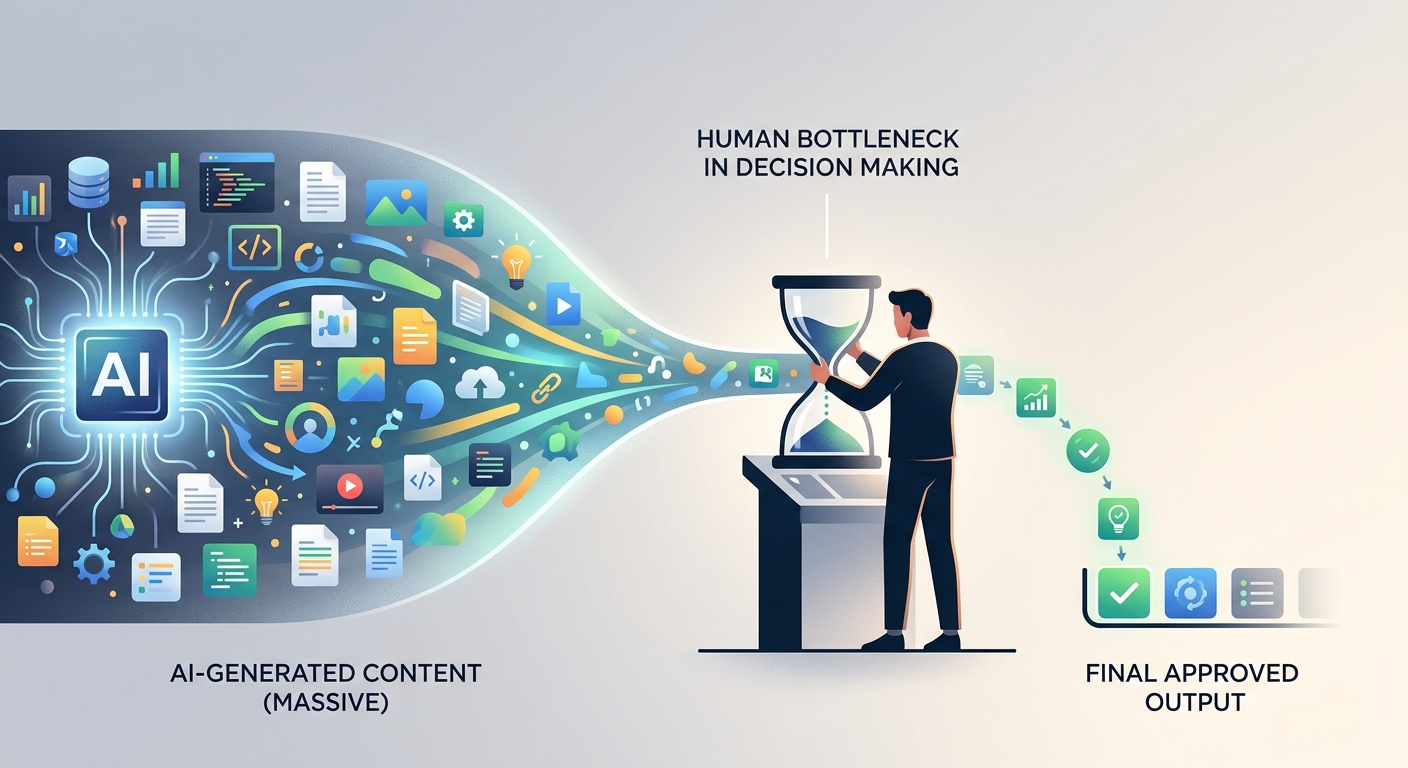
AI is changing the economics of creation. The bottleneck is shifting away from making things toward deciding what is worth making. As the cost of generating products, software, designs, and content approaches zero, competitive advantage moves elsewhere.
Competitive advantage moves from production capability to decision quality. Companies that invest only in AI generation tools risk producing more mediocre work faster. Leadership attention shifts toward prioritization, customer insight, and strategic judgment.
Instead of investing weeks building a concept before testing it, AI enables organizations to generate many versions rapidly. That changes innovation from “Build → Launch → Learn” to “Generate → Test → Learn → Repeat”.
Source: Play, experimentation, and the rise of the hybrid creative (IDEO)
Top News
1. OpenAI released GPT-5.6 Sol, a frontier model focused on stronger coding, knowledge-work, and cybersecurity.
2. Meta introduced Muse Spark 1.1, a multimodal reasoning model.
3. xAI released Grok 4.5, its newest model for coding, agentic tasks, and knowledge work.
4. OpenAI introduced ChatGPT Work, an agent for longer tasks across apps.
5. Salesforce announced a major Agentforce Commerce release for deploying AI agents.
6. Google highlighted Business Agent for Leads and related AI ad tools.
Additional Insights
1. AI creates a workforce dividend. Invest it for growth. (PwC)
PwC argues that the central leadership challenge of AI is not whether it will eliminate jobs, but how organizations will reinvest the human capacity AI creates. The article introduces the concept of an “AI workforce dividend”—the time, expertise, and resources freed up by AI-driven productivity gains—and contends that companies should view this dividend as fuel for growth rather than simply a source of cost savings. Instead of focusing primarily on layoffs or reskilling existing workers, leaders should first identify new markets, products, and customer opportunities enabled by AI, then redeploy and reskill employees to pursue those opportunities, hiring only where new capabilities are needed and reducing roles only as a last step. PwC cites its 2026 AI Jobs Barometer, which found that organizations most exposed to AI are experiencing twice the headcount growth of the least exposed, with jobs emphasizing human judgment, creativity, and expertise growing faster and often commanding higher pay. The article concludes with an “AI dividend test” that encourages executives to define AI-driven growth opportunities, measure the capacity AI creates, redesign the workforce around strategic priorities, and build talent mobility so employees can transition into higher-value roles. PwC’s overarching message is that organizations that reinvest AI gains into innovation and expansion will build more durable competitive advantages than those that use AI primarily to shrink costs.
2. How AI Is Accelerating Scientific Discovery (HAI)
The Stanford HAI article explains that AI is fundamentally changing scientific discovery by acting as a powerful research partner rather than replacing scientists. Modern AI systems can rapidly review literature, generate hypotheses, analyze massive datasets, design experiments, and identify patterns that would be impractical for humans alone, accelerating progress across biology, medicine, engineering, and other fields. The article highlights examples such as Evo 2, a large DNA language model that predicts and designs genetic sequences to advance disease research and crop improvement, and Stanford’s effort to build a virtual human cell foundation model that could enable researchers to simulate cellular behavior, speeding drug discovery and personalized medicine. It also discusses research showing that while large language models often produce more novel scientific ideas than human experts, those ideas are frequently less feasible, underscoring that human judgment remains essential. Overall, the article argues that AI’s greatest value lies in augmenting scientists—making research faster, more collaborative, and more accessible—while emphasizing the need to address challenges such as bias, data quality, and equitable access so these tools can deliver trustworthy and broadly shared scientific benefits.
3. AI agents aren’t the end of SaaS – they’re driving its next phase of growth (Techradar)
The article argues that AI agents are not replacing SaaS—they are accelerating its evolution into a more valuable enterprise layer. While AI agents can interact with APIs, automate workflows, and reduce reliance on traditional user interfaces, organizations still need SaaS platforms to provide the underlying business logic, permissions, governance, integrations, audit trails, and execution infrastructure that agents depend on. Rather than competing with AI, successful SaaS vendors are embedding agents into their products and shifting from being primarily interface-driven applications to becoming trusted orchestration and control systems for autonomous work. This transition favors deeply integrated enterprise platforms over superficial point solutions, as AI-generated activity actually increases the demand for software that can securely manage, validate, and scale those actions. The article concludes that the next generation of SaaS will be defined less by human-facing features and more by its ability to coordinate AI-driven operations, with Gartner forecasting that by 2030, 85% of AI investments will be delivered through existing SaaS and cloud platforms rather than standalone AI products.
4. Research: AI Is Changing What Employers Want from New Hires (HBR)
The article argues that generative AI is not diminishing the value of skilled professionals but fundamentally raising expectations for them. Based on research across banking, consulting, and technology firms, the authors identify three capabilities that will define successful knowledge workers: first, the ability to take on broader, AI-enabled roles as routine tasks are automated and traditional job boundaries converge; second, the ability to synthesize information across functions, critically evaluate AI-generated insights, and combine domain expertise with systems thinking to drive innovation; and third, the ability to redesign workflows around AI agents by determining what should be automated, establishing guardrails, and overseeing AI performance rather than simply inserting AI into existing processes. The study concludes that employers are investing in upskilling experienced professionals rather than replacing them, and that future hires will need not only strong business or technical fundamentals but also demonstrated AI fluency, sound judgment, and practical experience using AI to solve real business problems.
5. How Leaders Can Use AI to Solve Real Business Problems (HBR)
The interview argues that organizations should stop treating AI as a goal in itself and instead use it as a tool to solve clearly defined business problems. Josh Tyrangiel contends that much of the AI hype is driven by commercial incentives from AI companies, while successful implementations depend on domain experts, strong management, clean data, realistic expectations, and iterative experimentation rather than faith in “magic” technology. He highlights the Cleveland Clinic as an example, where clinician-led AI projects improved hospital operations and reduced sepsis mortality by integrating AI into existing workflows instead of forcing workflows around AI. Tyrangiel also emphasizes that human judgment, organizational culture, transparency with employees, and customer needs remain essential because AI cannot replace expertise or management. His advice to leaders is to communicate openly about AI initiatives, focus on specific use cases, treat deployments as research and development rather than guaranteed transformations, and invest in solving real business problems instead of chasing AI adoption for its own sake.
6. Anthropic found a hidden space where Claude puzzles over concepts (MIT Tech Review)
Anthropic has reported a major interpretability result: researchers discovered an emergent internal “global workspace” inside Claude, dubbed J-space, where the model appears to hold and manipulate concepts before (or without) expressing them in text. Using a new technique called the J-lens, they found that this workspace isn’t the model’s visible chain of thought but a separate set of internal neural representations that emerged during training. Experiments showed these representations are causally important—altering a concept in J-space (for example, changing an internal representation of “spider” to “ant”) changes Claude’s answers accordingly. The researchers argue this resembles the “global workspace” theory from neuroscience, though they explicitly do not claim Claude is conscious. Instead, they suggest the discovery could make AI systems more transparent and safer by exposing hidden concepts, detecting deceptive or misaligned behavior before it appears in outputs, and providing a way to study how large language models internally reason rather than treating them as complete black boxes.