
Highlights
Top Insights
The biggest economic value may shift away from the agents themselves toward the infrastructure that allows millions or trillions of agents to work together.
Most companies are racing to build AI agents for specific tasks (customer support, travel, finance, coding). Ramesh Raskar argues that this is similar to building websites before creating the internet itself. The larger opportunity is creating the infrastructure agents need:
- Identity
- Discovery
- Authentication
- Reputation
- Payment
- Coordination
- Legal and compliance services
Source: Who will own the AI agent economy? (Ideas Made to Matter)
Top News
1. xAI launched Grok 4.5 as its strongest model for coding, agentic tasks, and knowledge work.
2. Thinking Machines Lab released Inkling, its first open-weights multimodal model, with customization support through Tinker.
3. Moonshot AI released Kimi K3, a 2.8-trillion-parameter open-weight model with native vision and long-context capabilities.
4. Google AI Mode added app-linking and interaction support for services including Instacart, Canva, and YouTube.
5. China is accelerating its push to become a global AI leader by promoting open source AI.
Additional Insights
1. Designing GenAI for the Emotional Side of Money (IDEOU)
Johannes Seemann developed the idea for Sooner, an AI-powered financial planning tool, years before generative AI made it technically feasible. His research at Wells Fargo revealed that financial decisions are driven less by math than by identity, emotions, and trust. Rather than replacing financial advisors or automating decisions, Sooner is designed to help people better understand their own relationship with money through conversational psychographic profiling and flexible “intentions” instead of rigid financial goals. Seemann emphasizes a human-centered approach: validate real user needs before applying new technology, design AI to support rather than control users, and prioritize how the experience feels over what AI can automate. He also highlights three persistent AI design challenges—normative contamination (injecting unintended value judgments), false coherence (oversimplifying human contradictions), and context rot (losing important context over long conversations)—arguing that these require ongoing design work rather than simple prompt engineering. His key advice is to solve meaningful human problems first, involve real users throughout development, preserve user agency, and remain willing to change direction when evidence shows a better path.
2. Rewiring customer experience for the agentic era (McKinsey)
Agentic AI fundamentally changes customer experience (CX) by shifting companies from designing fixed customer journeys to orchestrating real-time decisions across channels and touchpoints. While AI alone cannot create competitive advantage if layered onto fragmented processes, organizations with strong CX foundations—clear customer promises, human-centered design, structured workflows, and disciplined governance—are well positioned to scale agentic AI successfully. The authors describe a three-stage evolution: Horizon 1 focuses on automating individual workflows (such as customer support and account setup), Horizon 2 coordinates multiple workflows across a business domain to create seamless experiences, and Horizon 3 envisions an ecosystem-wide decision engine that continuously optimizes customer interactions across functions, channels, and partners. Successful adoption requires redesigning workflows around decisions rather than tasks, establishing shared customer context, defining governance and human oversight, tracking decision quality, and balancing autonomy with trust, privacy, and reversibility. Ultimately, the article concludes that organizations treating agentic AI as a strategic redesign of customer experience—not merely another automation tool—will build stronger customer loyalty, operational efficiency, and long-term competitive advantage.
3. 5 ways to make agentic AI a competitive advantage (Ideas Made to Matter)
The article argues that enterprises can gain a competitive advantage from agentic AI by rethinking how work is organized rather than simply adding AI to existing processes. MIT Sloan’s Paul Cheek and Paul McDonagh-Smith recommend that organizations embrace AI agents by redesigning workflows, setting realistic goals focused on measurable improvement instead of perfection, and understanding AI’s limitations so humans continue to provide judgment and oversight where needed. They also stress that strong data governance is essential for moving AI projects from experimentation into production, that organizations should formally define accountability for AI systems—including compliance, bias, and maintenance—and that leaders should evaluate AI use cases based on business impact, risk, feasibility, and where human relationships remain most valuable. Ultimately, the authors argue that companies that successfully adapt their organizational structures and human-machine collaboration will be better positioned to compete with AI-native startups.
4. Is that AI agent worth it? Agentic economics and the modern operating model (McKinsey)
The McKinsey article argues that while AI model costs per token have fallen dramatically, enterprise spending on AI continues to surge because agentic AI systems consume far more compute through long-running workflows, iterative refinement, orchestration, and context management. Rather than optimizing for token costs alone, CEOs should evaluate AI based on business outcomes—asking whether an AI agent creates more value than it costs to operate. The authors identify six drivers of rising AI costs (including long-lived context, refinement overhead, variable autonomy, overuse of expensive models, orchestration complexity, and inefficient information structures) and argue that competitive advantage is shifting away from proprietary models toward proprietary data, contextual knowledge, and the ability to govern machine work effectively. They recommend treating AI as a strategic operating capability by routing workloads to the appropriate models, measuring cost per business outcome, investing in contextual data, clarifying ownership of AI operations, rethinking outsourcing decisions, and adopting a portfolio approach to build-versus-buy choices. Ultimately, the article concludes that organizations which develop disciplined “agentic economics” and manage AI with the same rigor as capital, labor, and operations will gain a sustainable competitive advantage, while those focused only on reducing AI bills risk scaling costs without realizing corresponding business value.
5. Five principles for designing brain-powered organizations (McKinsey)
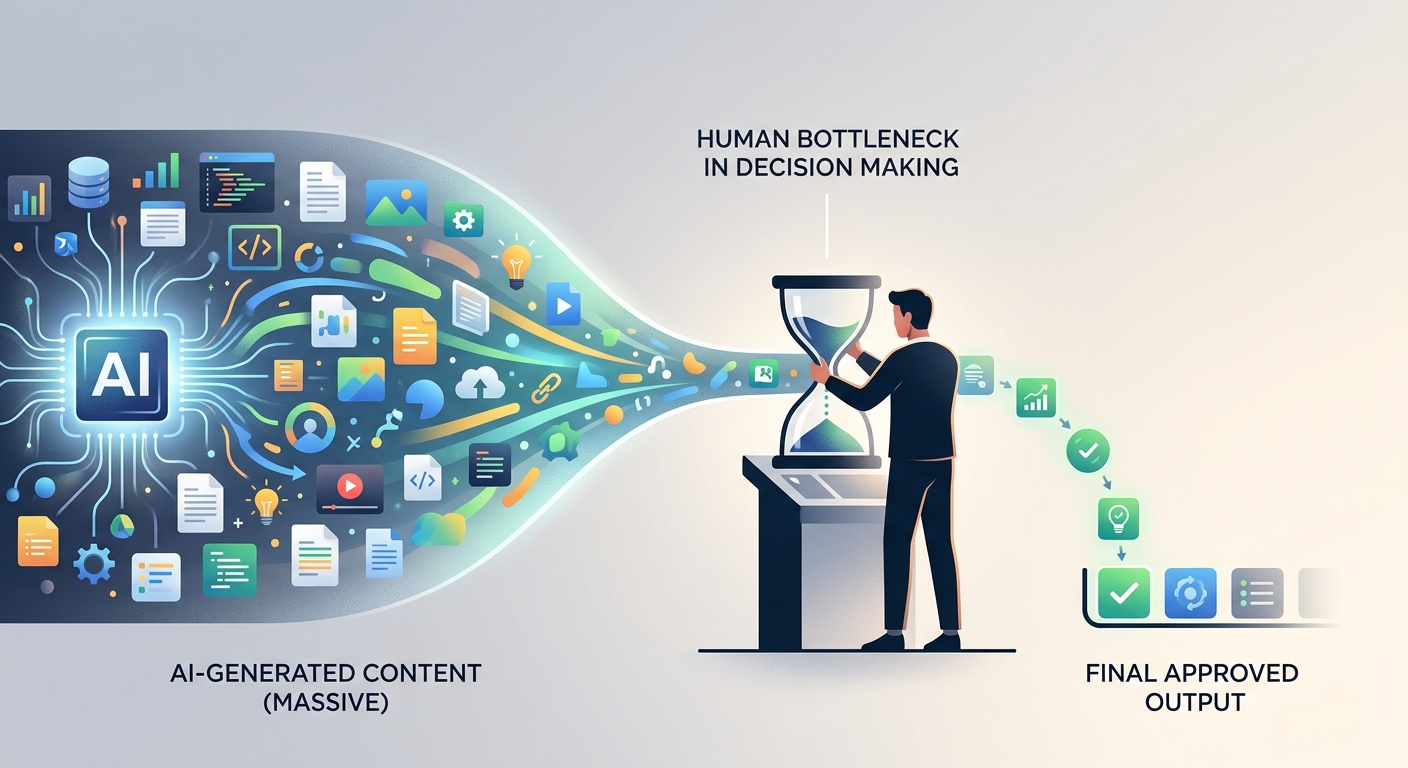
McKinsey argues that the biggest barrier to realizing AI’s value is no longer the technology itself, but the cognitive capacity of the people expected to use it. While AI can dramatically improve productivity, overreliance may lead to cognitive offloading, reduced critical thinking, mental fatigue, and burnout if organizations simply layer AI onto existing work without redesigning jobs. To address this, the authors propose five principles for building “brain-powered organizations”: (1) calibrate cognitive load by ensuring AI removes routine work while humans focus on judgment and creativity; (2) protect cognitive capacity by embedding recovery, reducing unnecessary meetings, and eliminating low-value work; (3) build adaptive brain skills such as critical thinking, emotional intelligence, collaboration, and learning agility so employees retain capabilities AI cannot replace; (4) enable sustained focus by designing work environments that minimize interruptions and support deep work; and (5) create a brain-positive environment that treats employees’ mental health and cognitive development as strategic assets. The central message is that organizations should keep humans at the steering wheel and AI in the loop, redesigning work around both technological capabilities and human neuroscience. Companies that intentionally invest in employees’ “brain capital” will be better positioned to scale AI successfully and achieve lasting business value, while those that ignore the human side risk automating their way to exhaustion rather than transformation.