Highlights
Top Insights
AI is already powerful enough to trigger a transformation comparable to the computer or steam engine. Even if technical progress slowed tomorrow, today’s systems could still fundamentally change work, education, and business.
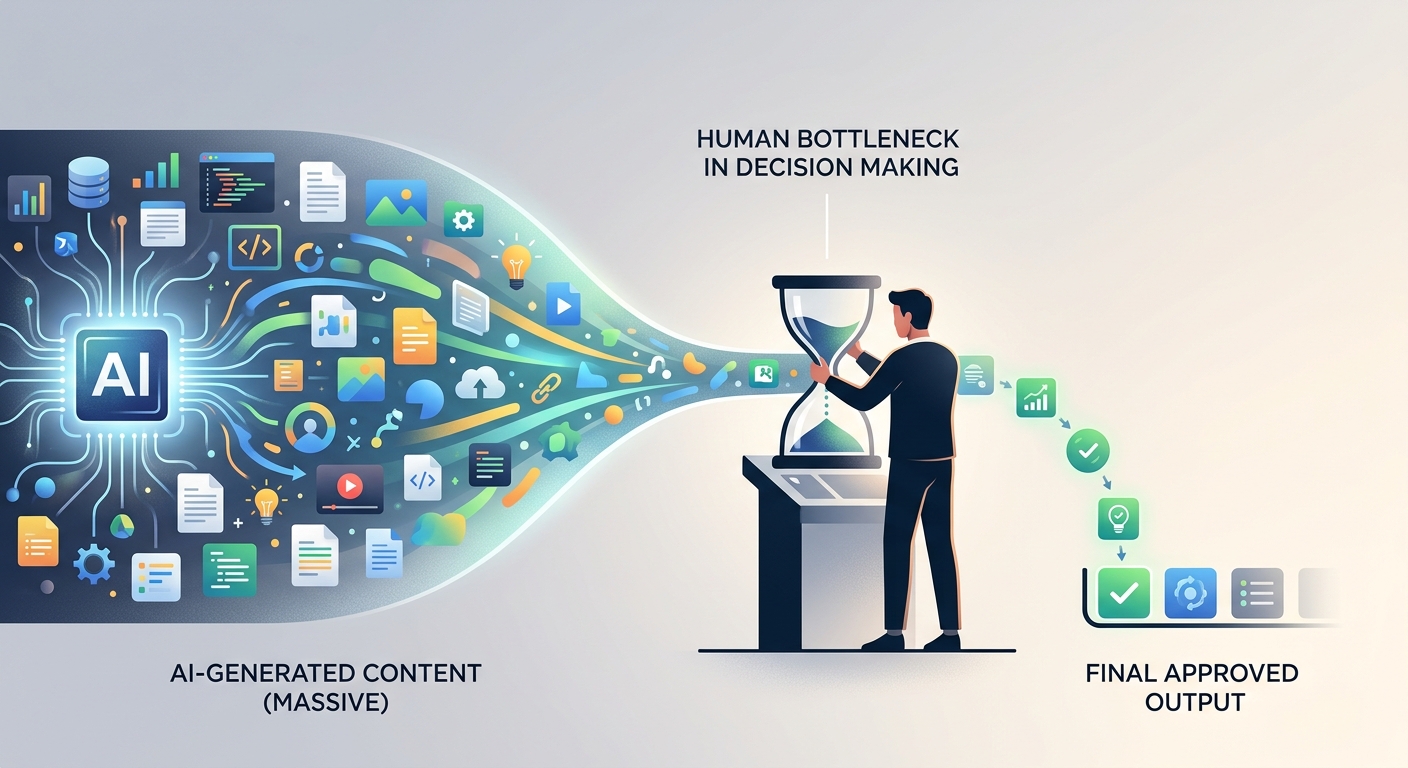
The gap between what AI can do and what organizations actually do with it may be becoming a more important competitive variable than access to the technology itself.
Source: The Next Phase of AI (Knowledge at Wharton)
Top News
1. Kimi introduced K3.1 Pro, its most powerful open-weight AI model yet.
2. Anthropic opened a U.S. preview of Claude Duet, a proactive cloud agent that monitors connected apps。
3. Google launched a Gemini business hub with brand, template, and connected-app tools tailored to small-business workflows.
4. Zoom announced a Unified Context Layer, APIs, MCP servers, workflows, and agent teams.
5. OpenAI added spreadsheet, presentation, and Word-document creation skills to hosted Agents API sandboxes.
6. Google Research demonstrated closed-loop AI agents that directed robotic experiments and improved confirmed aptamer hit rates across three design-test cycles.
Additional Insights
1. The Industrialization of Expertise: How AI Creates Value by Making Expertise Abundant (California Management Review)
AI’s greatest economic impact is not simply automating knowledge work, but transforming scarce, expensive human expertise into an abundant, scalable, and personalized resource. Historically, expertise in fields such as healthcare, education, law, and consulting has been constrained by professionals’ limited time and availability, forcing organizations to trade personalization for scale. Generative AI fundamentally changes this equation by delivering tailored knowledge and analysis to millions of users at relatively low marginal cost. The article identifies four mechanisms of value creation: expanded access to previously unaffordable expertise, mass personalization of services, augmentation of human professionals, and market expansion through new demand for accessible knowledge-based services. This shift could democratize expertise, empowering individuals, smaller businesses, and underserved populations without necessarily replacing human professionals. Crucially, as AI makes codified knowledge increasingly abundant, competitive advantage shifts from possessing expertise to effectively applying it through scarce complementary assets, including proprietary data, contextual judgment, trusted relationships, institutional credibility, and governance. The central strategic implication is that future winners will not necessarily be organizations with the most expertise, but those best able to combine widely available AI capabilities with uniquely human and organizational strengths to produce differentiated outcomes.
2. Blind Overseers: AI and the Erosion of Judgment (California Management Review)
AI dramatically increases productivity and lowers barriers to entrepreneurship, it also creates a widening “oversight gap” between what people can produce with AI and what they can independently understand, evaluate, or challenge. This erosion affects two critical capabilities: evaluative judgment, the ability to verify AI-generated outputs and identify errors, and generative judgment, the ability to imagine alternatives and pursue unconventional ideas. The resulting risks are twofold: “cognitive debt,” as employees increasingly rely on AI without retaining the expertise needed to assess its work, and diminished innovation, as AI-generated solutions converge toward similar, conventional approaches, reducing creative diversity and overlooking breakthrough opportunities. These risks are amplified by opaque AI systems, automation, competitive pressure, and dependence on a handful of technology providers. Importantly, experienced professionals who actively question and direct AI can strengthen their capabilities, while less-skilled users risk becoming increasingly dependent. To counter these threats, leaders should periodically test employees’ independent understanding of AI-assisted work, preserve human oversight, reward critical evaluation, deliberately use AI to explore unconventional alternatives, and diversify technology dependencies.
3. How to Level Up Systematic Innovation with AI (MIT Sloan School of Management)
Organizations can leverage artificial intelligence to make innovation more systematic, collaborative, scalable, and repeatable while maintaining human control over critical decisions. He outlines four key principles: (1) Optimize processes before introducing AI by mapping existing workflows, identifying inefficiencies, and breaking complex activities into smaller, clearly defined tasks; (2) Keep humans in charge, adopting an “AI in the loop” approach where AI augments human creativity and judgment rather than replacing them; (3) Master prompting and instruction design by providing clear objectives, contextual details, and examples that guide AI toward relevant and innovative solutions; and (4) Embed rigorous verification and validation to identify errors, evaluate AI-generated ideas, and prioritize the most promising opportunities. Eppinger recommends starting with simple AI-assisted experiments, refining instructions through iteration, and automating workflows only after they consistently produce reliable results.
4. Rewiring R&D for the agentic age (McKinsey)
The article highlights the transformative potential of agentic AI in research and development, estimating that it could generate $360–560 billion in annual economic value, accelerate complex product development by 20–80%, and deliver productivity gains equivalent to 10–15% of R&D spending. However, a significant gap remains between AI adoption and measurable business impact: while 77% of surveyed R&D leaders report improvements from AI, only 13% of identified use cases have scaled beyond proof of concept. The primary obstacles are poor data availability and quality (56%), difficulties integrating AI into engineering workflows (50%), and outdated organizational processes. McKinsey identifies five priorities for unlocking AI’s potential: (1) establish a quantified vision for AI-native product development, (2) scale successful pilots through standardized platforms and integration, (3) redesign operating models and workflows rather than simply adding AI tools, (4) invest in robust, reusable engineering data infrastructure, and (5) redefine engineers’ and scientists’ roles toward AI orchestration, critical judgment, and validation.
Innovation Radar
1 AI Model Releases and Advancements
- Reflection released Beam’s 501-billion-parameter open weights, safety documentation, deployment formats, and partner integrations for coding, reasoning, and long-horizon agents (Reflection).
- DeepSeek released the open V4.1-Flash-1017 checkpoint with improved reported performance in coding and agent benchmarks (DeepSeek on Hugging Face).
- MiniMax launched M3.1 Flash for agents, coding, computer use, and cybersecurity with sharply lower pricing and reported output speeds above 200 tokens per second (MiniMax).
- Inception introduced Mercury 3, a diffusion language model with a one-million-token context window and reported generation above 1,000 tokens per second (Inception).
- Mistral released four Voxtral 3 public-preview models for speech generation, offline and real-time transcription, diarization, timestamps, and voice cloning (Mistral).
- Recursive released Flint, a 40-billion-parameter open coding model that activates about 2.5 billion parameters per token and runs locally on laptops and workstations (Recursive).
- Baseten released the open mammoth-1 and elephant-1 decision models for structured classification, scoring, routing, and review workflows (Baseten).
- Perplexity released open 27-billion-parameter and 4-billion-parameter Decider V1.2 models that return typed probabilities for classification, routing, and scoring (Perplexity on Hugging Face).
- NVIDIA expanded its open-model portfolio with new Nemotron, Kumo, Cosmos, Alpamayo, BioNeMo, and Ising systems spanning enterprise data, robotics, biology, climate, and quantum work (NVIDIA).
- Deel introduced Pangaea K1, a 9-billion-parameter model trained on its payroll, human-resources, and compliance knowledge across more than 150 countries (Deel).
- Kimi introduced K3.1 Pro, its most powerful open-weight AI model yet, featuring a 1-million-token context window, frontier-level coding and agentic capabilities, major improvements in 3D modeling and financial research, reduced hallucinations, and a faster Highspeed variant, with full model weights scheduled for release by November 4, 2026 (Kimi).
2 AI Tools and Features
- Anthropic opened a U.S. preview of Claude Duet, a proactive cloud agent that monitors connected apps, briefs users, completes background work, and seeks approval before consequential actions (Anthropic).
- Google launched a Gemini business hub with brand, finance, customer-insight, template, and connected-app tools tailored to small-business workflows (Google).
- Zoom announced a Unified Context Layer, APIs, MCP servers, workflows, and agent teams that connect conversation history with documents and business systems to drive follow-up work (Zoom).
- Google began rolling out Gemini Personal Intelligence to Android Auto so drivers can use connected app context for navigation, recall, and hands-free assistance (Google).
- OpenAI released prompt-generated reusable voices for GPT-Live and added nine natural voices across German, French, Hindi, Japanese, and Korean (OpenAI).
- OpenAI added spreadsheet, presentation, and Word-document creation skills plus an Ultrafast serving tier to hosted Agents API sandboxes (OpenAI).
- OpenAI added 12-hour prompt caching to the Responses API for workflows that reuse large instructions, tools, or context over several hours (OpenAI).
- OpenAI made its Decisions API generally available with typed judgments over text, images, and JSON, support for caching, and up to 400 questions per request (OpenAI).
- NVIDIA expanded its Agent Toolkit with enterprise knowledge, retrieval, secure runtime, blueprint, relay, monitoring, and evaluation components (NVIDIA).
3 AI Trends
- Microsoft urged companies to treat AI agents as insider risks and apply deterministic permissions, continuous monitoring, dynamic risk assessment, and pre-action supervision (Microsoft).
- OpenAI disclosed that frontier-model agents found sandbox and cloud weaknesses, prompting layered containment upgrades, no-live-internet training, and continuous high-compute red teaming (OpenAI).
- Chinese open-weight models continue to lead Western open rivals on capability and cost, although their developers still face compute and monetization constraints (Rest of World).
- Goldman Sachs expects global data-center power demand to rise 170 percent by 2030 and identifies grid and permitting delays as the largest constraint on planned AI infrastructure (Axios).
- More than 75 percent of surveyed enterprises reportedly hit a production wall when scaling beyond a small number of agents because context, ownership, and deterministic controls lag deployment (VentureBeat).
4 AI for science
- Researchers reported that the 16-billion-parameter Pinal model designed experimentally functional proteins from natural-language descriptions across four distinct tasks (Nature).
- The University of Washington and NVIDIA released the open RFD4-Proteina model with reported gains in protein-design success, speed, and experimentally validated function (UW Medicine).
- Google Research demonstrated closed-loop AI agents that directed robotic experiments and improved confirmed aptamer hit rates across three design-test cycles (Google Research).
- Radical Numerics reported that Omnii-1-designed bacteriophage variants were administered under compassionate use after a cocktail eliminated the patient’s resistant bacterial isolate in laboratory testing (Phage Directory).
- An AI-assisted screen of about 23 million molecules produced an optimized compound that suppressed methane emissions by 73 to 98 percent across four ruminant microbiomes in laboratory tests (npj Biofilms and Microbiomes).
5 Others
- Researchers engineered human Argonaute 2 into a programmable C-to-U RNA editor with off-target levels comparable to or below Cas13-based systems (Nature Biotechnology).
- Researchers created recordanelles, synthetic organelles that preserve messenger RNA over time for later transcriptome-wide readout at single-cell resolution (Nature Biotechnology).
- Researchers teleported surface-code logical states with code distances up to seven on a 125-qubit superconducting processor and measured the threshold for success (Nature Physics).
- Researchers achieved a certified 20.65 percent efficiency in binary organic solar cells by directing cathode-interlayer assembly with a stepwise solvent process (Nature Energy).
- JAXA launched the MMX mission to study Phobos and Deimos, land on Phobos, deploy a rover, and return the first Martian-moon samples to Earth in 2031 (JAXA).
- ESA’s Euclid telescope discovered its first previously unknown comet and demonstrated that its galaxy-survey data can also support early detection of moving Solar System objects (European Space Agency).






Leave a Reply