
Highlights
Top Insights
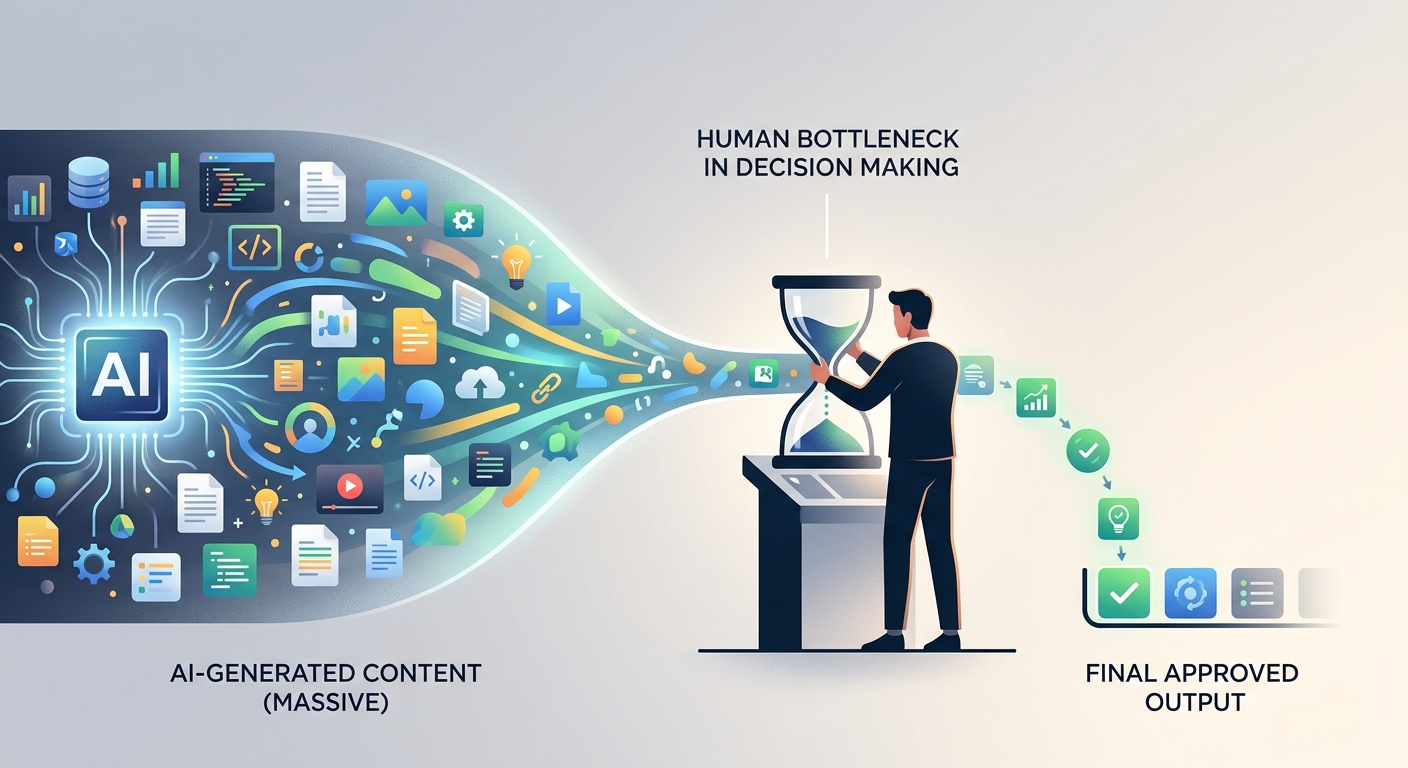
AI errors compound when every handoff in a process uses AI. A recruiter uses AI to write a job description, candidates use AI to optimize résumés, HR uses AI to screen them, and candidates may use AI during interviews. The process starts assessing who uses AI best rather than who fits the job best.
AI governance cannot stay at the employee-tool level. The real risk sits in end-to-end processes: hiring, procurement, claims, legal review, customer research, performance management, and compliance.
Each time information is passed through an AI model, summarized, rewritten, or regenerated, it can drift further from the original facts. Cross-company workflows are especially exposed. Healthcare payer-provider exchanges, supplier documentation, contract negotiations, regulatory submissions, and customer-support escalations can all become less reliable if AI-generated content circulates without source controls.
Source: Don’t Let AI Slop Muck Up Your Company’s Processes (Harvard Business Review)
Top News
1. Z.ai’s GLM-5.2 open-weight model became available with long-context coding-agent improvements and an MIT license.
2. OpenAI released LifeSciBench to evaluate AI systems on realistic life-science research workflows.
3. Microsoft’s Work IQ APIs became generally available to give agents richer context across Microsoft 365 data and workflows.
4. Databricks introduced Genie One, Genie Agents, and Genie Ontology for data-grounded business agents. Databricks also open-sourced Omnigent, a meta-harness for composing and governing multiple AI agents.
5. Google’s June Pixel Drop added Gemini Omni video editing and Gemini music generation tools to Pixel devices.
6. Nature reported that AI tools are accelerating research into new antibiotics for drug-resistant infections.
Additional Insights
1. Pro-worker AI, explained (Ideas Made to Matter)
The article argues that AI’s greatest workplace value may come not from replacing workers, but from expanding what they can do: MIT economists Daron Acemoglu, David Autor, and Simon Johnson distinguish between technologies that merely automate, augment, or level expertise and those that create new tasks, with only the last category being clearly “pro-worker.” Pro-worker AI increases demand for human judgment and expertise by helping employees tackle more complex, data-rich work, as seen in examples like AI-supported patent examination and Schneider Electric’s troubleshooting tools for electricians. The business case is that companies using AI to redesign work around expanded human capability can improve quality, customer experience, innovation, and talent retention, while firms focused only on labor-cost reduction may miss AI’s broader transformative potential.
2. Lessons from Chinese AI Firms on Owning Customers’ Habits (Harvard Business Review)
1. AI Model Releases and Advancements
- Z.ai’s GLM-5.2 open-weight model became available with long-context coding-agent improvements and an MIT license. (Featherless)
- OpenAI introduced Deployment Simulation to test candidate models against realistic conversation contexts before release. (OpenAI)
- OpenAI released LifeSciBench to evaluate AI systems on realistic life-science research workflows. (OpenAI)
- Google DeepMind published an AI Control Roadmap for securing increasingly capable AI agents inside organizations. (Google DeepMind)
- Google DeepMind published a report on possible technical pathways from AGI toward artificial superintelligence. (Google DeepMind)
2. AI Tools and Features
- OpenAI added Enterprise and Edu credit controls, analytics views, and Codex Record & Replay. (OpenAI Help Center)
- Microsoft made Copilot Cowork generally available worldwide for Microsoft 365 Copilot customers. (Microsoft)
- Microsoft’s Work IQ APIs became generally available to give agents richer context across Microsoft 365 data and workflows. (Microsoft)
- Databricks introduced Genie One, Genie Agents, and Genie Ontology for data-grounded business agents. (Databricks)
- Google’s June Pixel Drop added Gemini Omni video editing and Gemini music generation tools to Pixel devices. (Google)
- HPE and NVIDIA expanded HPE AI Factory with agent governance, confidential computing, and new AI infrastructure components. (HPE)
- Databricks open-sourced Omnigent, a meta-harness for composing and governing multiple AI agents. (Databricks)
3. AI Trends
- Epoch AI found hyperscaler cash capex is on trend to overtake operating cash flow around Q3 2026. (Epoch AI)
- Major launches this week showed agent governance, cost controls, and permissions becoming core product requirements. (Google DeepMind)
- OpenAI’s Partner Network underscored the shift from tool adoption toward partner-led AI operating-model transformation. (OpenAI)
4. AI for science
- OpenAI described physician-led AI work to help reanalyze rare childhood disease cases. (OpenAI)
- OpenAI’s LifeSciBench benchmark focuses on real life-science workflows rather than narrow factual questions. (OpenAI)
- Nature reported that AI tools are accelerating research into new antibiotics for drug-resistant infections. (Nature)
- Science argued that scientific computing must integrate AI with simulation while prioritizing energy-efficient methods. (Science)
5. Others
- Snap opened preorders for its standalone AR Specs, with shipments expected in fall 2026. (The Verge)
- Nature reported that a two-drug cooling approach limited stroke injury in mice in new research. (Nature)
- Researchers reported a two-stage treatment that redirected mammalian healing toward complex tissue regrowth in animal studies. (ScienceDaily)
- Space-based data centers gained attention as a possible answer to AI compute demand, though major technical and cost barriers remain. (ScienceDaily)
- Federal regulators ordered grid operators to speed power-access planning for AI data centers. (AP)