
Highlights
Top Insights
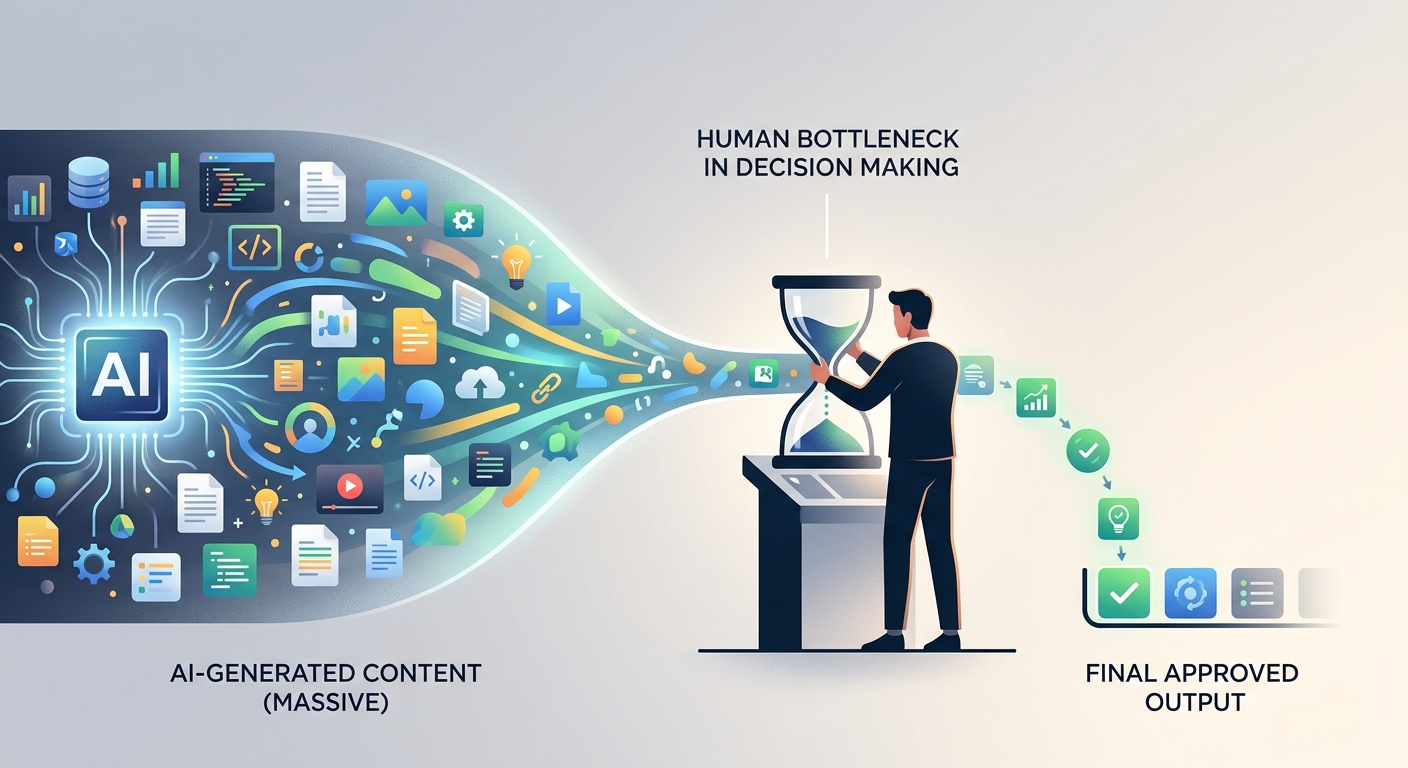
AI is no longer viewed as “another technology rollout.” CEOs and boards are initiating AI adoption. Business leaders are demanding implementation plans. IT is often the cautious party. This changes organizational power dynamics.
Executive education on AI increasingly focuses on people, systems, and organizational behavior, instead of technical mastery. AI adoption is becoming less like installing software and more like introducing a new class of digital employees. That changes management itself.
Executives increasingly realize AI is fundamentally about redesigning work. Not just automating tasks, or reducing costs. But redefining team structures, decision rights, managerial layers, and the boundary between human and machine labor.
Source: What senior leaders want to know about AI (Ideas Made to Matter)
Top News
1. Google introduced Gemini 3.5 Flash as the first Gemini 3.5 model, positioning it as a frontier-intelligence model. Google debuted Gemini Omni Flash as a “create anything from any input” model family that combines reasoning with generation. Google Workspace added Gmail Live, Docs Live, Google Pics, AI Inbox updates, and Workspace-linked Gemini Spark hooks.
2. Alibaba announced the Zhenwu M890 AI chip alongside an upgraded Qwen model for stronger coding and reasoning performance.
3. OpenAI launched a U.S. Pro preview that lets ChatGPT users connect financial accounts.
4. Google DeepMind published Co-Scientist in Nature as a multi-agent system for structured scientific reasoning and hypothesis generation.
5. OpenAI’s reasoning system generated a counterexample that helped overturn a long-standing Erdős conjecture.
Additional Insights
1. AI Tools for Researchers, Patterns vs. Insights, and When to Trust AI Output (IDEOU)
AI can accelerate research by surfacing patterns, organizing large datasets, and helping researchers explore questions faster, but Angela Kochoska of IDEO argues that human judgment remains essential for turning those patterns into meaningful insights. She distinguishes AI-generated “patterns” from true “insights,” emphasizing that insight comes from researchers interpreting findings through lived experience, fieldwork, and collaborative synthesis. Kochoska warns that AI naturally flattens nuance toward the average unless researchers actively guide it with thoughtful prompting, iterative context management, and critical evaluation. She also describes warning signs of “outsourcing your thinking” to AI—such as passively accepting long outputs without understanding them—and stresses that good research prompting is fundamentally about asking better questions, not merely getting faster answers. Human-centered innovation, she explains, emerges from team conversations, immersion in the field, and embodied experiences AI cannot replicate. While she recommends tools like Claude, Perplexity, NotebookLM, and SciSpace for different research tasks, she repeatedly returns to the idea that AI should expand researchers’ capabilities rather than replace human reasoning. Ultimately, Kochoska frames AI as a collaborative thought partner that can help researchers reach baseline understanding quickly, while the deeper specificity, creativity, and strategic insight still come from the deliberate intellectual friction of human thinking and experience.
2. AI-driven peer recommendation systems can enhance creativity in social networks (npj AI)
AI-driven peer recommendation systems can measurably improve creativity in social networks by intelligently guiding who people learn from. Using a system called SocialMuse, researchers combined semantic analysis and network structure modeling to recommend peers that maximize creative outcomes. In controlled experiments with 420 participants, AI-assisted networks generated more distinct, less redundant, and more semantically diverse ideas than control groups. The study also found that creativity improves when inspiration sources are partially decentralized rather than concentrated around a few “superstars,” suggesting that balanced exposure to diverse peers helps ideas stand out. Importantly, the findings position AI not as a generator of creative content, but as a facilitator of more effective human creative collaboration and discovery.
3. What leaders still get wrong about AI (Ideas Made to Matter)
Most organizations still fail to turn AI experimentation into measurable business value because they approach AI like a traditional IT initiative instead of redesigning how the business operates around it. MIT CISR researchers identify five recurring mistakes: treating AI as an end in itself rather than a tool for outcomes; launching projects without a clear value path; getting trapped in pilots instead of scaling enterprise-wide; overlooking how AI reshapes business models; and confusing personal productivity gains with strategic value creation. The article argues that successful AI adoption requires strong data capabilities, stakeholder involvement, AI-ready teams, interoperable platforms, governance built around human-centered AI, and a relentless focus on measurable outcomes such as revenue growth, cost reduction, or customer impact. It also distinguishes between generative AI “tools” that improve individual efficiency and integrated AI “solutions” that transform workflows and business models at scale, emphasizing that long-term competitive advantage comes from embedding AI into operations, decision-making, and customer outcomes rather than simply automating tasks.
4. Your AI Change Is Actually a People Change (BCG)
AI transformation failures are rarely about the technology itself. The article argues that 70% of AI transformation value comes from people-related actions, yet most companies still focus primarily on tools and infrastructure. Even more striking, executives dramatically misread employee sentiment: while 76% of leaders believe employees are excited about AI, only 31% actually are. Successful companies also do less, not more. They focus on just three or four high-impact AI use cases instead of spreading efforts across many initiatives. Perhaps the strongest takeaway is that employees often resist AI not because they fear efficiency, but because they fear losing identity, craftsmanship, and meaning in their work.
5. AI super-apps are remaking China’s internet (The Economist)
China’s internet is entering a third major phase driven by “AI super-apps” that can autonomously choose, buy, and arrange delivery of goods and services for users. The article explains that after the eras of Baidu-style web search and mobile super-apps like WeChat, Chinese tech giants such as Alibaba, Tencent, and ByteDance are now racing to integrate powerful AI agents directly into their ecosystems. Alibaba has linked its Qwen chatbot with Taobao, ByteDance is pairing Doubao with Douyin, and Tencent is embedding AI into WeChat’s vast network of mini-programs. These companies see AI agents as both a growth opportunity amid weak consumer spending and a defensive strategy against future AI-native devices that could disrupt today’s platforms. The competition is intense because whoever controls these agentic AI ecosystems could dominate China’s next internet era, while firms like Xiaomi and Huawei may also challenge incumbents by embedding AI deeply into smartphones, cars, and operating systems.
6. Google I/O showed how the path for AI-driven science is shifting (MIT Technology Review)
Google I/O 2026 highlighted a major shift in AI-driven science: from highly specialized scientific tools like AlphaFold and WeatherNext toward more general-purpose, agentic AI systems that can independently contribute to research. The article contrasts DeepMind CEO Demis Hassabis’s ambitious “foothills of the singularity” rhetoric with practical scientific AI applications such as hurricane prediction, arguing that Google is increasingly prioritizing autonomous AI “co-scientists” over narrowly trained systems. While specialized tools remain influential—AlphaFold is widely used and continues powering drug discovery efforts—Google and the broader industry are investing heavily in LLM-based agents capable of hypothesis generation, coding, algorithm optimization, and even original mathematical discoveries. Initiatives like Gemini for Science, AI Co-Scientist, and AlphaEvolve reflect this transition toward AI systems that may eventually collaborate with, or potentially surpass, human scientists. The article suggests that Google’s long-term vision is no longer merely AI-assisted science, but the possibility of superhuman scientific agents driving breakthroughs beyond current human cognitive limits.