Highlights
Top Insights
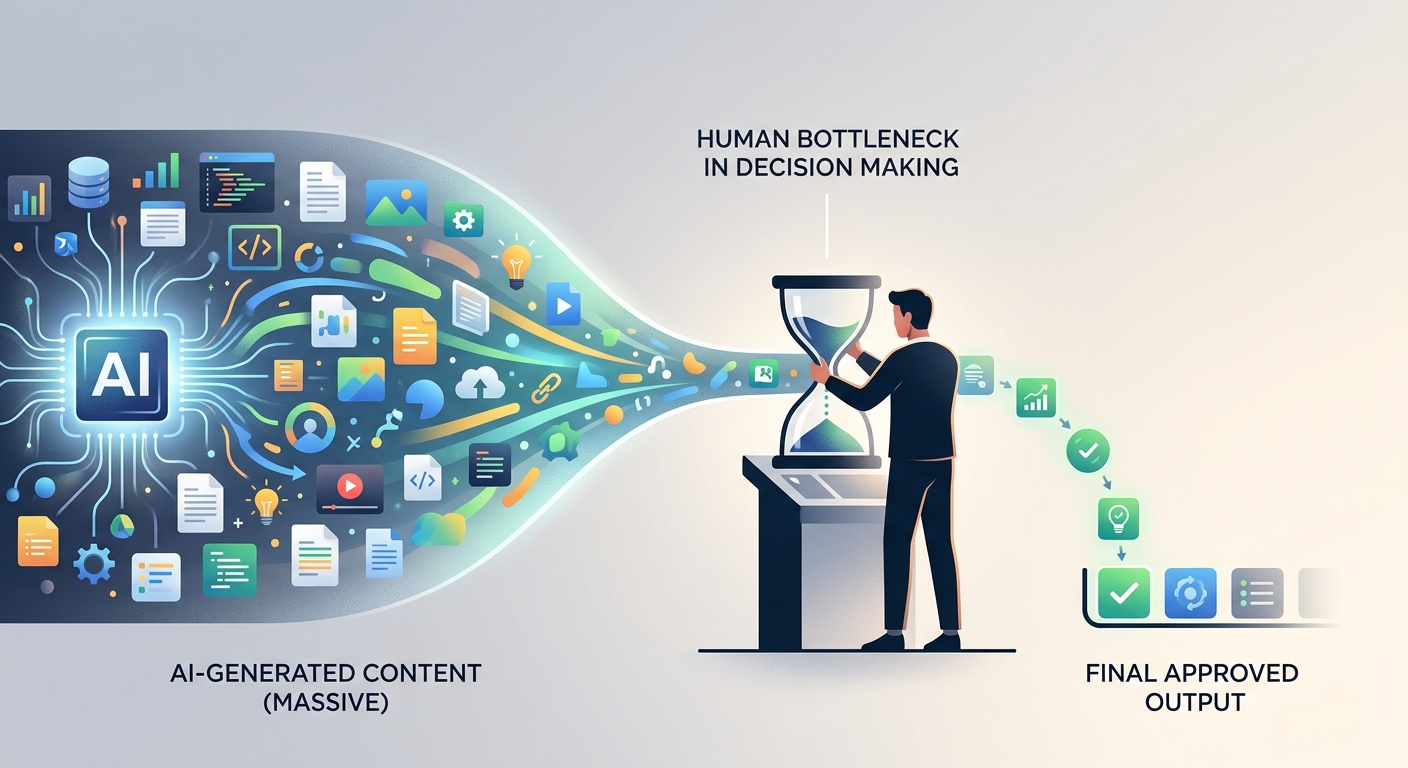
Most companies are using AI like a better tool (write emails, summarize docs). That’s the wrong frame. The research shows AI’s real impact comes from restructuring entire workflows: how tasks are sequenced and handed off between humans and machines.
AI creates value when multiple steps are linked into a continuous chain, not used in isolation. But there’s a catch:
- If one step in the chain is hard for AI → it breaks the whole system
- If adjacent steps are AI-friendly → value compounds
Source: How AI is reshaping workflows and redefining jobs (Ideas Made to Matter)
Top News
1. OpenAI introduced GPT-5.5 as a more capable and efficient flagship model, ChatGPT Images 2.0 with improved precision, and workspace agents in ChatGPT.
2. xAI introduced Grok Voice Think Fast 1.0, a low-latency voice model optimized for complex enterprise workflows.
3. Google announced the Gemini Enterprise Agent Platform for building, deploying, and managing agents with enterprise integrations
4. DeepSeek has previewed its new V4 AI model, with notable gains in coding and compatibility with China’s domestic chips
Additional Insights
1. The AI dividend (IDEO)
AI-driven efficiency creates an “AI Dividend”, a surplus of time, capacity, and cognitive resources, but efficiency alone will not produce lasting competitive advantage because it quickly becomes commoditized. Instead, organizations must reinvest this dividend into human-centered creativity, judgment, and innovation, shifting from traditional, coordination-heavy structures to adaptive, decentralized systems built around small autonomous teams and parallel experimentation. The real transformation is architectural: like factories redesigned around electricity, companies must redesign themselves around AI, reducing bureaucracy and unlocking new forms of productivity. Those that do will compound advantages over time by continuously reinvesting gains into exploration and creative capacity, while those that focus only on cost reduction risk converging into indistinguishable “AI slop.” Ultimately, leadership must evolve from control-oriented management to cultivating environments where creativity and adaptation can thrive, since the true frontier of value lies in what AI cannot yet replicate.
2. Three reasons why DeepSeek’s new model matters (MIT Tech Review)
DeepSeek’s new V4 model matters for three main reasons: it significantly advances open-source AI by offering performance comparable to top closed models at a fraction of the cost, making high-end capabilities more accessible to developers; it introduces a more efficient approach to handling long context (up to 1 million tokens) by selectively compressing less relevant information, dramatically reducing compute and memory requirements; and it represents an early step toward China reducing reliance on Nvidia by optimizing the model for domestic chips like Huawei’s Ascend, although full independence hasn’t yet been achieved. Overall, while V4 may not be as disruptive as its predecessor R1, it signals important progress in cost efficiency, technical architecture, and geopolitical shifts in AI infrastructure.
3. From promise to impact: How companies can measure—and realize—the full value of AI (McKinsey)
While AI adoption is widespread, most companies struggle to translate activity into measurable financial impact because they lack rigorous performance tracking and accountability. It proposes a five-layer framework linking technical performance, user adoption, operational KPIs, strategic outcomes, and ultimately financial results, emphasizing that true value comes from connecting model performance to business outcomes. Leading organizations stand out by defining value upfront, embedding measurement and attribution into deployments, and managing AI as a disciplined investment with governance, review cadences, and decision gates across stages from pilot to full scale. The key insight is that AI’s competitive advantage depends not on experimentation alone but on systematically proving, scaling, and sustaining measurable business impact.
4. Beyond Tomorrow: Four Scenarios for the World of 2050 (BCG)
BCG’s report outlines four plausible (not predictive) scenarios for the world in 2050, arguing that the next 5 years of decisions will shape long-term outcomes and that leaders should prepare for multiple futures rather than a single forecast. The scenarios span a wide range: AI Abundance, where global cooperation and regulated AI drive high productivity, shorter workweeks, and strong growth; Battling Blocs, where geopolitical fragmentation reduces trade, increases defense spending, and slows growth; Climate Coalition, where climate shocks trigger coordinated global action and a rapid transition to low-carbon systems with moderate growth; and Digital Darwinism, where rapid but weakly regulated technological progress boosts growth while concentrating wealth and increasing inequality. Across these futures, key variables like GDP growth, trade levels, energy systems, and social structures diverge completely, but the central insight is consistent: the future will likely remain within historically plausible bounds, and organizations should build resilience and flexibility now to succeed under very different global conditions.
Innovation Radar
1. AI Model Releases and Advancements
OpenAI introduced GPT-5.5 as a more capable and efficient flagship model with improvements in coding, research, and data analysis while maintaining similar latency to GPT-5.4 (OpenAI).
OpenAI launched ChatGPT Images 2.0 with improved precision and structured visual generation for business-ready graphics (OpenAI).
Google made Gemini Embedding 2 generally available as a multimodal embeddings model for search, retrieval, and recommendation systems (Google).
xAI introduced Grok Voice Think Fast 1.0, a low-latency voice model optimized for complex enterprise workflows (xAI).
Google launched Deep Research and Deep Research Max as autonomous research agents that generate structured reports from authoritative sources (Google).
DeepSeek has previewed its new V4 AI model, with notable gains in coding and compatibility with China’s domestic chips like Huawei’s (The Verge).
Moonshot AI’s Kimi K2.6 is pushing long-running agents beyond minute-scale tasks, with reported executions lasting 13 hours and even five days across coding, monitoring, incident response, and system operations (VentureBeat).
2. AI Tools and Features
OpenAI launched workspace agents in ChatGPT that can automate tasks across tools with scheduling, approvals, and enterprise controls (OpenAI).
Google announced the Gemini Enterprise Agent Platform for building, deploying, and managing agents with enterprise integrations (Google Cloud).
Google released a native Gemini app for macOS with system-level access to files and on-screen context (Google).
Google expanded AI Studio access with higher usage limits and model availability for subscribers (Google).
Google added personalized image generation in Gemini using Nano Banana 2 and Google Photos context (Google).
xAI released standalone speech-to-text and text-to-speech APIs for real-time voice applications (xAI).
Google Photos introduced AI-powered touch-up tools for quick image enhancements (Google).
Adobe launched CX Enterprise, an agentic system for orchestrating the full customer lifecycle (Adobe).
Adobe introduced Brand Intelligence and GenStudio updates to create a brand-aware AI content supply chain (Adobe).
Google launched Workspace Intelligence as a shared context layer across apps, projects, and collaborators (Google).
Google added new Workspace features including interactive Sheets visuals and agentic automation tools (Google).
Amazon updated Bedrock AgentCore with tools like a CLI and managed harness to accelerate agent development (AWS).
Google upgraded Gemini Cloud Assist to support proactive, agent-driven cloud operations (Google Cloud).
3. AI Trends
AI-driven brand visibility and discovery in generated answers are becoming measurable marketing priorities (Adobe).
The industry is moving from chatbot selection toward deciding which business processes AI should autonomously execute (Google Cloud).
AI is increasingly used for technology scouting, as shown by a model identifying fast-rising innovations using Wikipedia data (Nature).
4. AI for Science
OpenAI launched ChatGPT for Clinicians to support medical documentation and research workflows with high safety ratings (OpenAI).
Google’s Deep Research tools are being applied to regulated domains like finance and life sciences for evidence-based reporting (Google).
The NIH developed scSurvival, a machine learning model that predicts cancer survival risk using single-cell tumor data (NIH).
5. Other
Google introduced TPU 8t and TPU 8i, separating infrastructure for AI training and inference workloads (Google Cloud).
Google expanded Distributed Cloud AI to support data sovereignty and localized AI deployment (Google Cloud).
NVIDIA showcased a full-stack industrial AI platform including simulation, robotics, and vision systems at Hannover Messe 2026 (NVIDIA).
Post-quantum cryptography urgency increased as major tech companies accelerate migration timelines (Ars Technica).
Gene-editing advances for β-hemoglobinopathies highlighted continued progress in curative genomic medicine (Nature Medicine).
Breakthrough Prize coverage emphasized ongoing momentum in gene therapy and fundamental science innovation (Nature)