Highlights
Top Insights
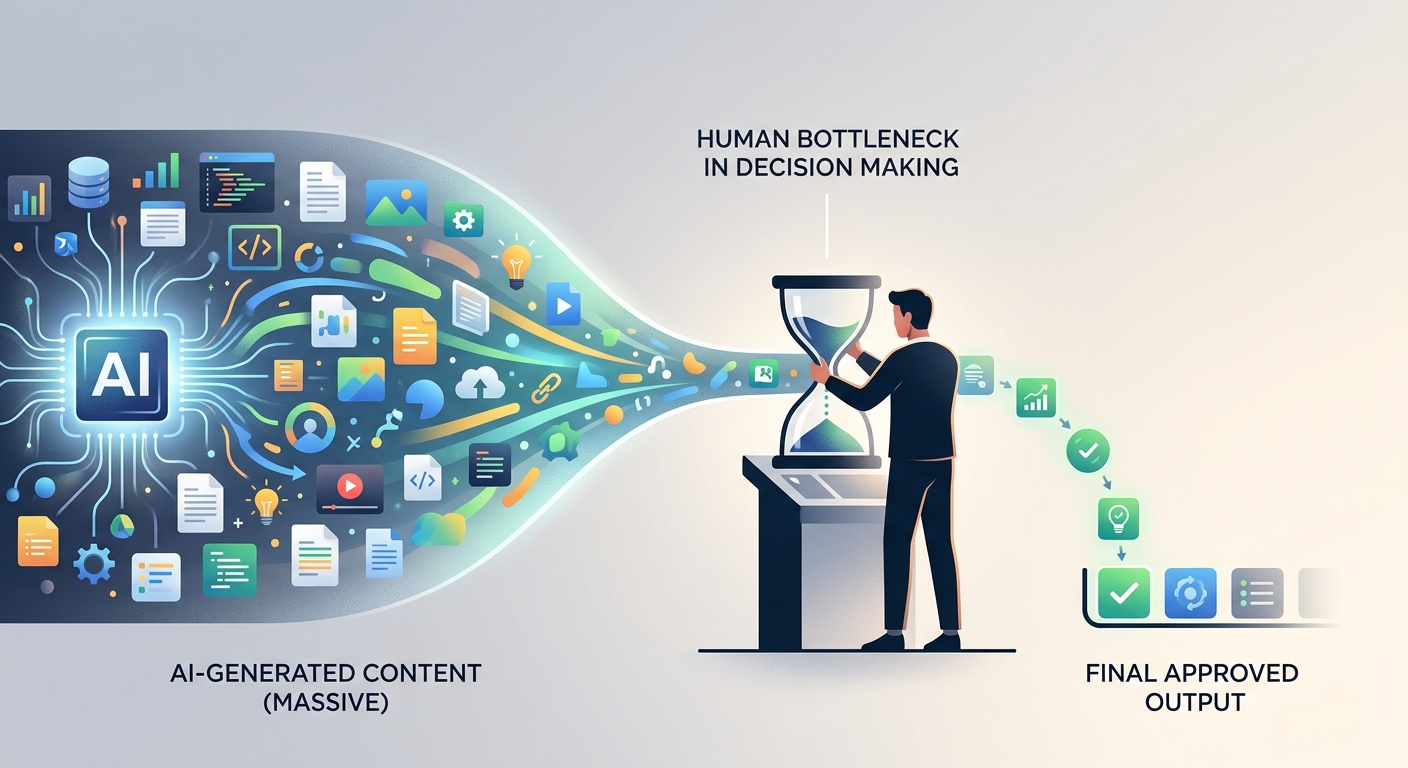
1. Leaders tend to frame AI as a productivity tool. Employees interpret it as a signal about their future. If AI = cost-cutting → employees assume “I’m replaceable”.
If AI = augmentation → employees assume “I’m being invested in”. That perception drives behavior far more than the tool itself.
2. Automation delivers quick, visible gains: fewer people, lower costs, faster output. But it triggers a predictable chain reaction:
Lower trust
Lower engagement
Lower quality (“workslop”)
Higher attrition
Weaker talent pipeline
Source: Why Companies That Choose AI Augmentation Over Automation May Win in the Long Run (HBR)
Top News
1. Anthropic released Claude Opus 4.7 as a more reliable frontier model for long-running tasks.
2. MiniMax open-sourced M2.7, a self-evolving agent model.
3. OpenAI introduced GPT-Rosalind, a domain-specific model for biology and life sciences.
4. Alibaba open-sourced Qwen3.6-35B-A3B, an efficient multimodal MoE model.
5. Google released a native Gemini app for Mac with system-wide access, file context, and multimodal capabilities.
6. Anthropic introduced Claude Design, enabling users to generate and refine visual assets.
Additional Insights
1. Inside the AI Index: 12 Takeaways from the 2026 Report (Stanford HAI)
The 2026 AI Index highlights a field advancing rapidly in capability while lagging in governance, equity, and sustainability. Frontier models now achieve near or beyond human-level performance in complex reasoning, science, and mathematics, and are increasingly contributing to real scientific discovery, yet they remain uneven, still struggling with practical planning, real-world tasks, and basic functions like time awareness. This progress comes with significant trade-offs: massive environmental costs, declining transparency among leading companies, and intensifying global competition, especially as China closes the gap with the U.S. At the same time, AI is reshaping economies and societies, with record-breaking investment and adoption but clear workforce disruption, particularly for younger workers. Public sentiment reflects this duality, combining optimism with rising concern about jobs and governance. Overall, AI is becoming deeply embedded across domains from education to healthcare, but the systems for managing its impact, from policy to measurement, are not keeping pace with its accelerating influence.
2. Frontier Systems for the Physical World (a16z)
AI is approaching a new phase beyond language and code, driven by the convergence of foundational “primitives” that enable systems to operate in the physical world, including learned models of physical dynamics, embodied action architectures, scalable simulation, expanded sensory inputs, and closed-loop autonomy. These primitives are maturing simultaneously and creating a compounding flywheel across three high-potential domains: robotics, autonomous science, and new human-machine interfaces. Each domain both leverages and reinforces the others by generating rich, physically grounded data and new capabilities, shifting AI from passive reasoning to active interaction with reality. The core insight is that the greatest breakthroughs will emerge not from isolated advances but from the interaction between scale, physical grounding, and new data modalities, positioning these systems as the next major frontier with the potential for qualitatively new capabilities and accelerating feedback loops across the entire AI ecosystem.
Innovation Radar
1. AI Model Releases and Advancements
Anthropic released Claude Opus 4.7 as a more reliable frontier model for long-running tasks, improved software engineering, and higher-quality professional outputs with added safety controls (Anthropic).
Microsoft introduced MAI-Image-2-Efficient, an image model up to 22% faster and 4x more efficient, designed for high-volume use cases like e-commerce and marketing (Microsoft).
Liquid AI released LFM2.5-VL-450M, a compact vision-language model optimized for real-time, edge-based structured visual understanding with sub-250ms latency (Liquid AI).
MiniMax open-sourced M2.7, a self-evolving agent model with strong coding and terminal benchmarks aimed at software and productivity workflows (MarkTechPost).
Google previewed Gemini Robotics-ER 1.6, improving robots’ ability to read instruments and perform spatial reasoning in industrial environments (Ars Technica).
Google introduced Gemini 3.1 Flash TTS, a cost-efficient and controllable text-to-speech model for expressive voice generation (Google).
OpenAI introduced GPT-Rosalind, a domain-specific model for biology and life sciences workflows with integrations across 50+ scientific tools (OpenAI).
Alibaba open-sourced Qwen3.6-35B-A3B, an efficient multimodal MoE model with strong agentic coding capabilities and reduced compute requirements (Alibaba Cloud).
2. AI Tools and Features
Adobe launched Firefly AI Assistant, a conversational interface that orchestrates multi-step creative workflows across its Creative Cloud suite (Adobe).
Google expanded AI Mode to support local commerce by checking product availability and pricing directly with nearby stores (Google).
Anthropic redesigned Claude Code to support parallel AI workflows with a multi-agent interface and integrated development tools (Anthropic).
Google introduced “Skills” in Chrome, enabling reusable prompt-based workflows that automate tasks directly within the browser (TechCrunch).
OpenAI updated its Agents SDK with sandboxing and controlled environments for safer enterprise agent deployment (TechCrunch).
Google released a native Gemini app for Mac with system-wide access, file context, and multimodal capabilities (TechCrunch).
Google upgraded AI Mode for side-by-side browsing and research, integrating live web pages into AI workflows (TechCrunch).
OpenAI revamped Codex to run in the background with parallel agents, integrations, and persistent workflow memory (TechCrunch).
Canva AI 2.0 added tool-calling, integrations, and workflow automation to generate and manage editable design assets (TechCrunch).
DeepL launched a voice translation suite for real-time multilingual communication across meetings and platforms (TechCrunch).
Anthropic introduced Claude Design, enabling users to generate and refine visual assets like slides and prototypes from prompts (TechCrunch).
3. AI Trends
Stanford HAI’s 2026 AI Index shows rapid growth in AI capability and adoption while governance, transparency, and evaluation frameworks lag behind (Stanford HAI).
TechCrunch reported on “tokenmaxxing,” where increased AI-generated code volume is not translating into real productivity gains due to higher rework and churn (TechCrunch).
Nature reported that human scientists still outperform AI agents on complex tasks despite widespread adoption of AI tools (Nature).
TechCrunch highlighted that AI-driven traffic to U.S. retailers rose 393% in Q1, making AI a meaningful commerce channel (TechCrunch).
Forbes emphasized a shift from AI dominance to AI independence, with companies prioritizing control, cost, and deployment over raw model power (Forbes).
TechCrunch noted a growing perception gap between AI insiders and the broader public, creating new change-management challenges (TechCrunch).
4. AI for Science
Nature highlighted that AI is augmenting rather than replacing scientists, with humans still leading complex research tasks (Nature).
5. Other
Dairy Queen is expanding AI voice ordering in drive-thrus to improve speed, consistency, and upselling in customer-facing operations (The Verge).
Researchers demonstrated a bioelectronic technique using lithium iron phosphate to precisely inhibit neural activity, combining battery chemistry with neurotechnology (Nature).
Advances in monolithic 3D photonics are enabling scalable multifunctional optical systems for communications and sensing (Nature).
A Nature Communications Medicine paper highlighted progress in RNA nanotechnology for regenerative medicine and chronic disease treatment (Nature Communications Medicine).