Highlights
Top Insights
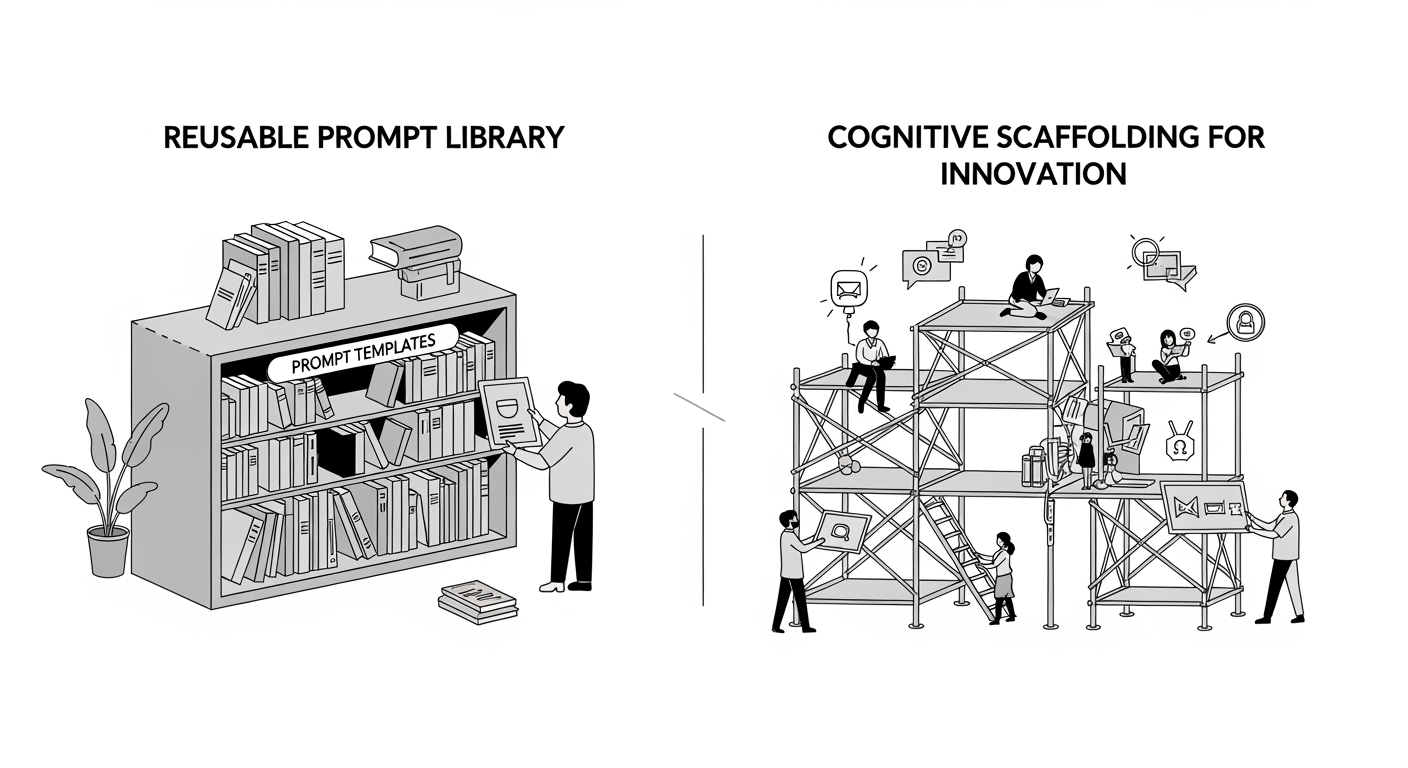
- The real value isn’t in “prompt engineering” as a craft but in curating a library of proven prompt templates that teams can reliably reuse across projects. We should treat prompts like intellectual property, standardize, share, and maintain them as part of our organization’s innovation toolkit.
- Templates expand creativity by giving structure to ideation and problem-solving at different stages of product development.
Source: Prompt engineering is so 2024 (Ideas Made to Matter)
Top News
1. DeepSeek has launched its upgraded open-source V3.1 model.
2. Alibaba introduced Qwen-Image-Edit, an image editing model that enables semantic and appearance editing.
3. Google is expanding AI Mode in Search globally while adding new agentic and personalized features.
4. Adobe launched Acrobat Studio, an AI-powered platform that unites PDFs, Adobe Express, and AI assistants into dynamic knowledge hubs.
5. The Chan Zuckerberg Initiative’s AI model rBio uses virtual cell simulations to accelerate biomedical research.
Additional Insights
1. Addressing Gen AI’s Quality-Control Problem (Harvard Business Review)
Amazon built an AI-driven quality-control loop where one AI checks another, experiments run automatically, and the system steadily improves from failures. This approach allows Amazon to test tens of millions of ideas a year, far more than human teams that rely on guesswork, and even small improvements add up to billions in revenue. Perhaps most strikingly, experiments revealed that long-held expert assumptions, such as customers always preferring white-background product photos, were often wrong. By challenging those assumptions with massive, automated tests, AI uncovered insights that humans had missed, showing that scale and experimentation can be more powerful than expertise alone.
2. The $1T Opportunity to Build the Next Amazon in Retail (Sequoia)
Five potential AI-driven retail models include: (1) AI-powered consultative shopping experiences, (2) Model Context Protocol (MCP) servers enabling transactions directly inside chat platforms, (3) predictive shipping that anticipates purchases, (4) roaming autonomous vehicle stores, and (5) computer vision–enabled predictive shopping with in-home sensors. Together, these innovations suggest a massive opportunity for AI-native retailers to redefine shopping and potentially create the next Amazon-scale company.
3. The future of AI-driven insights (Board of Innovation)
The future of consumer insights is shifting from studying human behavior to orchestrating intelligence in a world where decisions are increasingly shaped by AI. Three surprising shifts drive this change: AI agents are emerging as “non-human consumers” that influence most purchases by 2028, hybrid decision-making (System X) is blending human intuition with machine processing, and context is overtaking identity as the key to understanding behavior in real time. Traditional methods like focus groups and static profiles can’t keep up with this dynamic landscape. Instead, insights teams must evolve from being “archaeologists” who dig up past truths into “architects” who build continuous intelligence systems. This demands new capabilities—fluency in how algorithms think, networks for contextual sensing, tools for democratizing decision-making, and strong ethical frameworks. The insights function has the potential to become the intelligence backbone of enterprises, enabling them to navigate AI-driven markets faster and more responsibly than competitors.
4. A new look at how automation changes the value of labor (Ideas Made to Matter)
A new MIT study upends the usual story that automation always erodes jobs and wages, showing instead that its impact depends on which tasks get automated. When machines take over simpler tasks, the remaining work often becomes more specialized, boosting the value of human expertise and raising wages—even as overall employment in that role declines, as seen with bookkeepers. But when automation targets the expert tasks, jobs become easier to enter, competition increases, and wages fall, as with inventory clerks or taxi drivers post-GPS. This “expertise framework” highlights that automation doesn’t just reduce work but reshapes it, sometimes concentrating value in the hardest-to-replace skills. For employers, this means the effects vary widely: some roles may quietly shrink through attrition with higher pay, while others risk morale and retention challenges from lower wages. Ultimately, automation can either elevate or commoditize jobs, depending on how it alters the balance of expertise.
5. MIT report: 95% of generative AI pilots at companies are failing (Fortune)
Widespread adoption of tools like ChatGPT boosts individual productivity, but enterprise-scale transformation remains rare—only 5% of custom AI pilots reach production. Success is not driven by model quality or regulation but by whether systems can learn, adapt, and integrate into workflows. The best-performing organizations and vendors focus on process-specific customization, measure outcomes rather than demos, and rely on partnerships over in-house builds. ROI is most visible in back-office automation (e.g., reducing BPO and agency spend) rather than headline-grabbing front-office pilots. The report warns that the window to secure adaptive, memory-capable AI systems is closing quickly, and those that fail to act risk being locked out as peers build compounding advantages.
Innovation Radar
1. AI Model Releases and Advancements
Meta has released DINOv3, a 7-billion-parameter self-supervised image analysis model trained on 1.7 billion images, now available on GitHub for commercial use and capable of handling diverse image tasks with minimal adaptation (Meta).
Cohere has launched Command A Reasoning, an enterprise model, delivering secure, efficient, and scalable reasoning for complex agentic workflows, outperforming competitors in benchmarks (Cohere).
Anthropic has introduced a feature allowing Claude Opus 4 and 4.1 to end conversations only in rare, extreme cases of persistent harmful or abusive interactions, as part of ongoing research into AI welfare and safeguards (Anthropic).
DeepSeek has launched its upgraded V3.1 model, optimized for upcoming domestic chips with faster processing and hybrid reasoning modes (VentureBeat).
NVIDIA has released the Nemotron Nano 2 family AI models, delivering up to 6× faster inference, 128K context on a single midrange GPU, state-of-the-art reasoning accuracy, and unprecedented transparency with open data and training recipes for broad enterprise and research use (MarkTechPost).
Alibaba introduced Qwen-Image-Edit, an image editing model that enables semantic and appearance editing, precise bilingual text editing, and diverse creative applications such as style transfer, novel view synthesis, and fine-grained corrections (GitHub).
ByteDance released Seed-OSS-36B, a family of open-source 36B-parameter language models with a record 512K-token context, offering state-of-the-art performance in math, coding, and long-context reasoning, multiple variants for research and applied use, and free enterprise deployment under the Apache-2.0 license (VentureBeat).
2. AI Tools and Features
Microsoft has introduced the new COPILOT function in Excel for Windows and Mac, which lets users enter natural language prompts directly into formulas to analyze, summarize, classify, and generate content dynamically within spreadsheets using AI (Microsoft).
Google is replacing Google Assistant with Gemini for Home, a more powerful AI that offers hands-free help, smarter home controls, personalized answers, and natural conversations — including Gemini Live for expert, creative, and in-the-moment guidance (The Verge). Google is expanding AI Mode in Search globally while adding new agentic and personalized features that help users complete tasks like reservations, event bookings, and tailored recommendations, with sharing and collaboration options (Google).
Adobe launched Acrobat Studio, an AI-powered platform that unites PDFs, Adobe Express, and AI assistants into dynamic knowledge hubs for smarter productivity, content creation, and collaboration (Adobe).
Microsoft’s MindJourney lets AI simulate and explore 3D environments to improve spatial reasoning beyond static images (Microsoft).
3. AI for Science and Medicine
NASA, in partnership with IBM and others, has launched the Surya Heliophysics Foundational Model, an open-access AI system that improves solar flare forecasting and space weather prediction to better protect satellites, power grids, communications, and human spaceflight (NASA).
The Chan Zuckerberg Initiative’s new AI model rBio uses virtual cell simulations instead of lab experiments to accelerate biomedical research and drug discovery (VentureBeat).
4. Other
Fitbit is launching a Gemini-powered personal health coach in October that delivers personalized fitness, sleep, and wellness guidance through the redesigned Fitbit app and Premium (Google). Google’s 2025 “Made by Google” event unveiled the Pixel 10 lineup, Pixel Watch 4, Pixel Buds 2a, and expanded Gemini AI features in a late-night show–style format (Mashable).
Two Harvard dropouts are launching $249 “always-on” AI smart glasses that record, transcribe, and display real-time info from conversations, sparking major privacy concerns (TechCrunch).