
Highlights
Top Insights
-
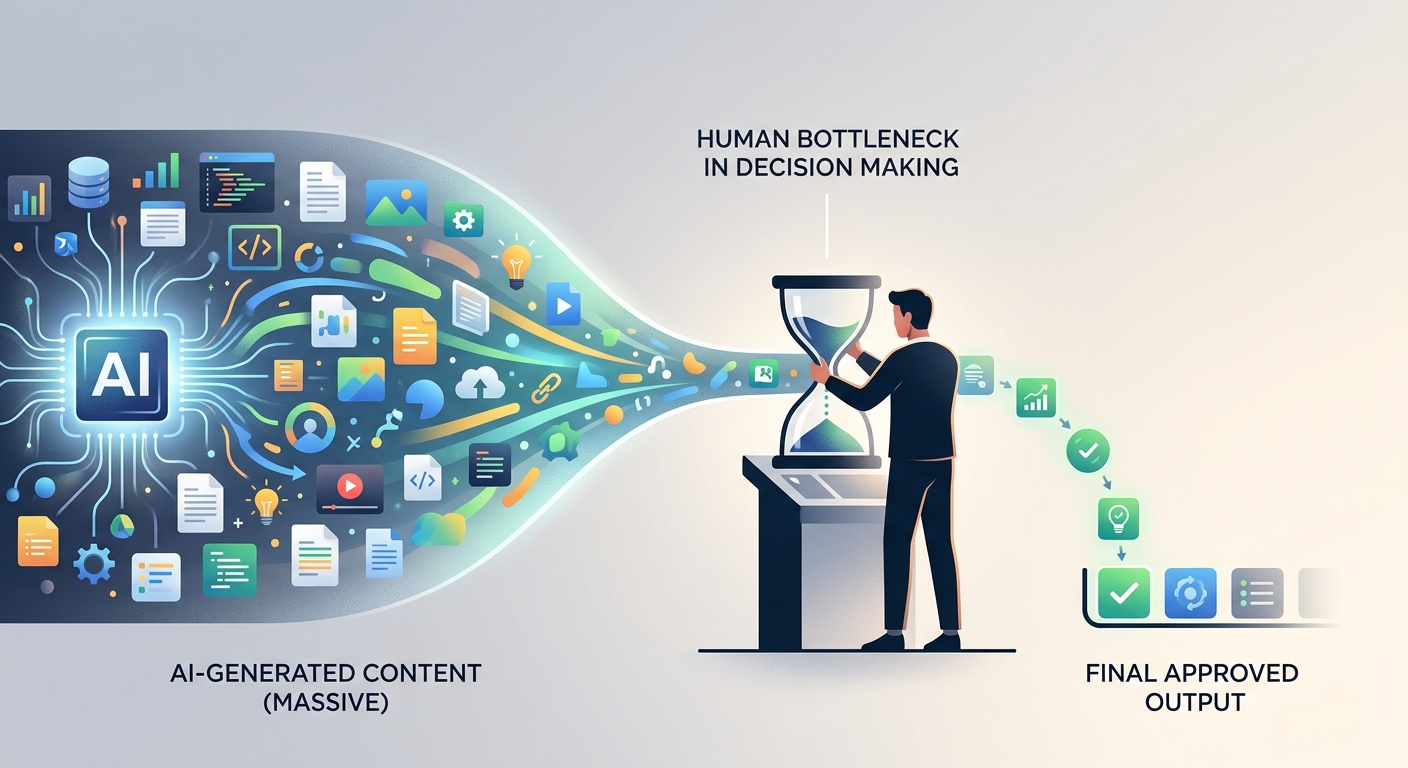
AI doesn’t just automate work, it can quietly erode core capabilities. The surprising risk is skill atrophy. As employees rely on AI for analysis and decisions, they stop developing judgment, intuition, and strategic thinking.
-
AI can bury critical decision logic inside opaque systems. Decisions that used to involve debate (e.g., credit approvals, promotions) become automated and invisible. The organization stops questioning its own rules.
-
AI weakens the social fabric that drives performance. AI reduces human interaction: fewer debates, less collaboration, less shared understanding. It also shifts perceived authority from people to systems.
Source: Don’t Let AI Destroy the Skills That Make Your Company Competitive (HBR)
Top News
- Researchers introduced a new framework for evaluating AI systems across tasks using generalized capability scales.
- ByteDance released Dreamina Seedance 2.0 in CapCut, enabling AI-generated videos with audio from text or images. Runway launched Gen-4, a model that generates consistent video scenes with stable characters, objects, and environments. Google released Veo 3.1 Lite, a lower-cost video generation model capable of producing short HD clips via the Gemini API.
- ChatGPT added write capabilities to integrations with Box, Notion, Linear, and Dropbox for in-app content generation.
- Google DeepMind released Gemma 4, a family of open-weight multimodal models (2B–31B) designed for agentic reasoning and on-device use.
- Alibaba has released Qwen3.6-Plus.
Additional Insights
1. How to build businesses faster and better with AI (McKinsey)
AI is fundamentally transforming venture building by dramatically improving innovation cycles, accelerating time to market, and enabling small teams to achieve outsized productivity. It highlights that AI allows companies to generate and test more ideas quickly, validate concepts earlier, and scale successful ventures with fewer resources, reshaping traditional constraints like team size and capital needs. Evidence shows ventures are reaching revenue milestones faster and with greater efficiency, with AI playing a central role in compressing timelines and boosting output per employee. The article emphasizes three critical shifts for leaders: raising performance expectations from incremental gains to step changes, building a strong AI-enabled data and technology backbone, and designing teams that encode and scale expert knowledge through AI systems. It also underscores that success depends on embedding AI across the entire venture lifecycle rather than treating it as a tool, with human–AI collaboration at the core. Ultimately, organizations that adopt an AI-first operating model can run more experiments, fail faster, and concentrate resources on high-potential opportunities, creating a compounding advantage in venture performance.
2. The IT department: Where AI goes to die (The Economist)
Companies are fundamentally mismanaging AI by treating it like conventional enterprise software, which strips away its transformative potential and reduces it to low-value automation. This normalization mindset leads firms to focus on efficiency gains and cost-cutting rather than reimagining what their organizations could become, pushing AI into risk-averse IT structures where experimentation dies. Instead, the author advocates embracing AI’s unconventional nature through a model of leadership-driven vision, broad employee experimentation, and dedicated innovation labs to generate and scale new use cases. A key risk of current approaches is that employees conceal their most impactful AI usage due to misaligned incentives, leaving organizations blind to real productivity shifts. Ultimately, firms that lean into AI’s uncertainty and creative potential can unlock entirely new capabilities, while those that normalize it will miss its strategic value and default to narrow automation outcomes.
Innovation Radar
1. AI Model Releases and Advancements
Google released Gemini 3.1 Flash-Lite and Flash Live, lightweight and audio-centric models designed for fast on-device AI and real-time voice interactions. (Google)
Google introduced Lyria 3 Pro, a generative AI model capable of producing high-fidelity music tracks and performing audio style transfers. (Google)
Google released Veo 3.1 Lite, a lower-cost video generation model capable of producing short HD clips via the Gemini API. (MarkTechPost)
Google DeepMind released Gemma 4, a family of open-weight multimodal models (2B–31B) designed for agentic reasoning and on-device use. (VentureBeat)
NVIDIA announced Cosmos 3, Isaac GR00T N1.7, and Alpamayo 1.5, advancing AI for robotics, simulation, and autonomous systems. (NVIDIA)
Runway launched Gen-4, a model that generates consistent video scenes with stable characters, objects, and environments. (Runway)
Anthropic is testing a next-generation model called Claude Mythos that significantly improves reasoning, coding, and cybersecurity capabilities. (Fortune)
Microsoft introduced MAI-Transcribe-1, MAI-Voice-1, and MAI-Image-2, a suite of models for speech, voice, and video generation. (TechCrunch)
Tencent open-sourced Covo-Audio, a 7B-parameter audio language model for real-time speech understanding and generation. (MarkTechPost)
Arcee AI released Trinity Large Thinking, a sparse MoE model optimized for long-horizon reasoning and agent workflows. (MarkTechPost)
Liquid AI launched LFM2.5-350M, a compact model trained on 28T tokens that achieves strong performance with high efficiency. (MarkTechPost)
Alibaba has released Qwen3.6-Plus, available through the Alibaba Cloud Model Studio API and offers a context window of one million tokens. (The Decoder)
2. AI Tools and Features
ChatGPT is now available in Apple CarPlay, enabling hands-free voice interactions while driving. (OpenAI)
ChatGPT added write capabilities to integrations with Box, Notion, Linear, and Dropbox for in-app content generation. (OpenAI)
ElevenLabs launched ElevenMusic, an AI app that generates songs from text prompts. (TechCrunch)
Google Vids introduced AI features including prompt-driven avatars and automatic video clip generation. (TechCrunch)
Salesforce added 30 AI features to Slack, including task automation, summarization, and AI skills via Slackbot. (TechCrunch)
ByteDance released Dreamina Seedance 2.0 in CapCut, enabling AI-generated videos with audio from text or images. (TechCrunch)
Intuit expanded its platform with AI agents for bookkeeping, payroll, and tax automation. (VentureBeat)
Kilo.ai launched KiloClaw, a platform to manage and govern enterprise AI agents securely. (VentureBeat)
3. AI Trends
Enterprise adoption of agentic AI is accelerating, with a majority of companies deploying or exploring AI agents for workflow automation. (Demand Gen Report)
There is a growing shift toward local “edge” AI models that reduce cloud costs and improve data privacy. (MarkTechPost)
4. AI for Science
Georgia Tech researchers developed POLYT5, an AI model that successfully designed a new polymer validated in lab experiments. (Phys.org)
Researchers introduced a new framework for evaluating AI systems across tasks using generalized capability scales. (Nature)
5. Other
Researchers developed a silicon–carbon nanotube battery anode that significantly increases energy density and lifespan. (TechXplore)
A new chipmaking method using a massive light source enables higher transistor density and faster semiconductor production. (Nature)
Nothing, the company, is reportedly developing AI-powered smart glasses and earbuds for real-time interaction with AI services. (TechCrunch)
Caltech researchers demonstrated that useful quantum computers may require as few as 10,000 qubits. (Phys.org)