Highlights
Top Insights
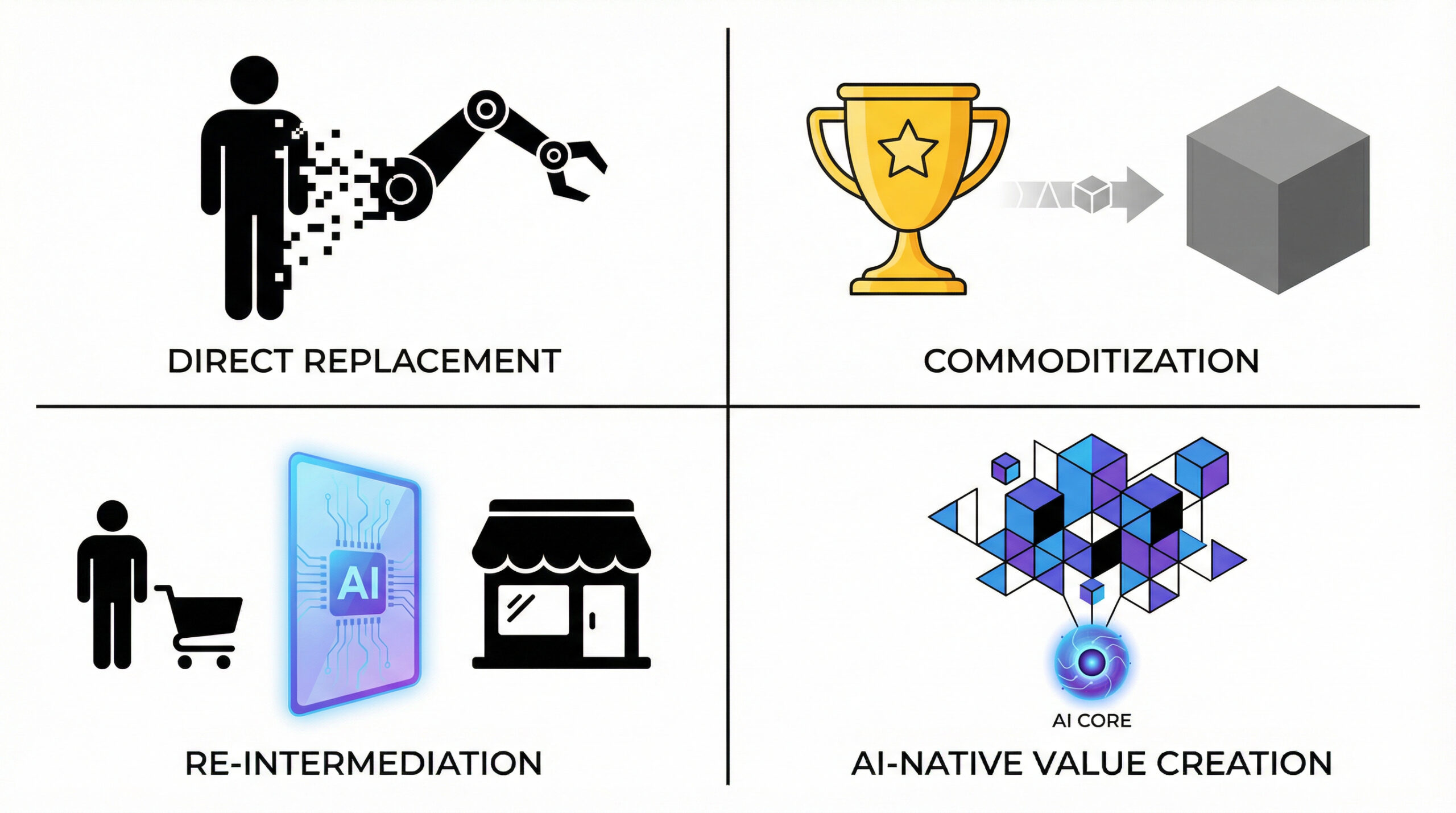
AI’s true impact isn’t just internal efficiencies, it reshapes what customers expect, how they interact with companies, and what they value. This goes beyond technology into where industry value pools and competitive advantages sit.
There are four AI disruption patterns: direct replacement of human execution; commoditization of what was once value-added; re-intermediation of customer interfaces; AI-native competitors and new value-creation logic.
Source: AI is shifting power, margins and control: How exposed is your business model to AI? (Board of Innovation)
Top News
1. Alibaba released its Qwen3.5 AI model series with improved performance, multimodal and agentic capabilities.
2. Anthropic launched Claude Sonnet 4.6, featuring broad upgrades in coding, computer use, long-context reasoning, agent planning, knowledge work, and design.
3. Google has launched Gemini 3.1 Pro, an upgraded AI model with significantly stronger reasoning and problem-solving capabilities.
4. Manus has launched Manus Agents, enabling users to access its full AI agent capabilities directly within Telegram chats.
Additional Insights
1. Beyond GDP: A Shared Opportunity for Growth and Job Creation (BCG)
BCG argues that traditional GDP growth is no longer a reliable proxy for economic well-being or job opportunity in the face of rising inequality, demographic shifts, automation, climate disruption, and other global challenges, and that countries should adopt new approaches that deliberately link growth with job creation and broader economic access; it proposes a multidimensional framework centered on redefining progress with better metrics, strengthening workforce resilience, expanding access to economic opportunities, fostering human-centered innovation, and scaling enterprise-led growth, with structured experimentation and rapid scaling across public and private sectors to drive productivity, resilience, and shared prosperity beyond mere GDP gains.
2. When Every Company Can Use the Same AI Models, Context Becomes a Competitive Advantage (HBR)
The article argues that as AI models become widely accessible and commoditized, organizational context—not technology access—will determine competitive advantage. Context is defined as the real, lived patterns of execution across teams, including how decisions are sequenced, how risks are weighed, and how roles coordinate, much of which is invisible in formal systems like CRMs or ERPs. Based on analysis of work patterns across large enterprises, the authors contend that even companies in the same industry diverge significantly in execution due to accumulated, tacit knowledge embedded in daily operations. They assert that AI systems are inherently general and only create differentiated value when grounded in this specific operating logic, which explains why many AI pilots fail to scale beyond controlled environments. To capture value, leaders should engage in “context engineering” by instrumenting workflows, building a context library, integrating it as a runtime layer for AI, establishing governance, and tightly linking AI usage to measurable business outcomes. Ultimately, sustainable AI-driven performance gains come from systematically capturing and operationalizing institutional judgment rather than relying solely on model capability.
3. Financial Planning for Agentic & AI Systems: Managing Volatility in the Age of Autonomy (California Management Review Insights)
The article argues that financial planning must fundamentally evolve in the age of autonomous, agentic AI systems, as traditional budgeting and forecasting approaches are no longer adequate in environments where costs and value are dynamic and usage-driven rather than fixed. It highlights that finance teams need to shift from static control-oriented processes to agile, intelligent planning that continuously integrates usage, cost, pricing, and ROI into a coherent decision engine that can adapt in real time. In agentic AI systems, usage data becomes the central metric linking technical operations to financial performance, and understanding how value flows through the AI value chain is critical to forecast reliability. The piece also stresses that forecasting is a strategic exercise that requires visibility into adoption behavior, operational outcomes, and business context—not just mathematical modeling of costs. Finally, it calls for financial planning functions to become learning systems that orchestrate decisions across cross-functional teams, enabling organizations to navigate volatility and align technical outcomes with business objectives.