
Highlights
Top Insights
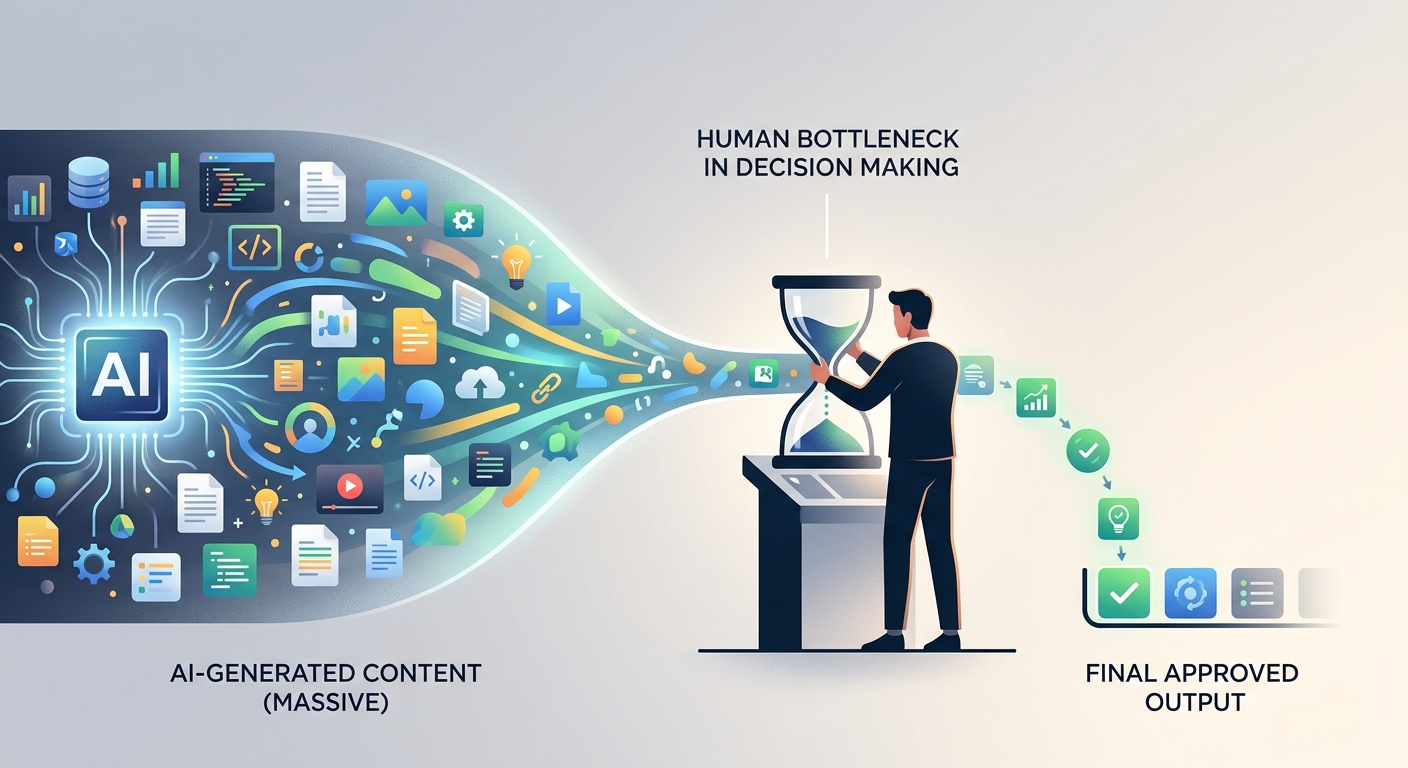
AI can improve the quality of information available to leaders while simultaneously weakening the quality of their judgment. In a field experiment involving 228 experienced evaluators, people often followed incorrect AI recommendations, and were even less likely to override the AI when it provided a persuasive narrative explanation. In other words, explainable AI can sometimes increase misplaced confidence rather than scrutiny.
Original judgment is the ability to see beyond the dominant narrative and make choices under uncertainty based on an independent interpretation of reality.
It depends on two capabilities:
Breadth of perception: noticing weak signals, anomalies, and patterns outside the obvious data.
Independence of interpretation: developing your own explanation instead of defaulting to the model’s or the group’s.
Source: AI Is Undermining Leaders’ Judgment. Here’s What to Do About It. (HBR)
Top News
1. Z.ai released GLM-5.3.
2. Alibaba’s Qwen team released Qwen3.8-27B weights on Hugging Face.
3. Anthropic expanded access to the cybersecurity capabilities of Claude Mythos 5.
4. Anthropic made computer use, the Skills API and the Files API generally available.
5. Google added least-privilege agent identities and data-loss-prevention controls to Workspace Studio.
Additional Insights
1. Provenance Grounds Trust in Autonomous Science (Nature Computational Science)
The article argues that trust in AI-driven autonomous science should rest less on making the AI itself interpretable and more on establishing rigorous provenance: a complete, persistent, re-openable record of what an autonomous system reasoned, did, observed, and measured.
2. An MIT Expert on Which Companies Will Succeed in the AI Era (MIT Sloan)
MIT Sloan researcher Andrew McAfee argues that the companies most likely to thrive in the AI-driven economy will be those that operate with the speed and adaptability of software startups rather than the management practices of 20th-century incumbents. His “geek way” emphasizes rapid experimentation, continual technological adoption, short iteration cycles, and organizational agility—traits illustrated by companies such as SpaceX and Netflix, which overturned established industries by doing things incumbents once considered impractical. McAfee believes economic value will increasingly concentrate among these agile firms and makes three broader predictions: the center of U.S. value creation will continue shifting west toward Silicon Valley and the Pacific Northwest; the world’s most valuable companies will continue getting younger as new entrants displace long-established corporations; and Europe will keep falling behind the U.S. because it produces comparatively few young, high-value technology companies.
3. From Experimentation to Execution: Why AI in B2B Marketing Must Now Prove Commercial Value (TechRadar Pro)
AI in B2B marketing has reached the point where experimentation is no longer enough: organizations need to embed it into everyday workflows and prove measurable commercial value. Khalid Aziz argues that the biggest risk is “shallow use”—deploying AI for isolated tasks rather than applying it across campaign planning, content, lead generation, sales enablement, measurement, and reporting. The strongest opportunities are to shorten sales cycles by removing friction and improving marketing-sales alignment; create differentiated, authoritative content that performs well as AI-driven search changes how buyers discover information; and use analytics, dashboards, predictive insights, and lead scoring to improve decision-making and demonstrate ROI. Crucially, AI should augment rather than replace human creativity, judgment, and storytelling, which means successful adoption depends as much on workforce training, collaboration, governance, and leadership as on the technology itself. The organizations likely to gain the most advantage will be those that invest in people and integrate AI strategically around clear business objectives, rather than simply buying more AI tools.
4. Crafting the last mile of delight (IDEO)
IDEO’s interview with Anthropic Head of Product Design Joel Lewenstein argues that AI is rapidly eliminating the “middle” of traditional design work—producing flows, components, drafts, research answers, and even code—while making two human capabilities more valuable: deciding what is worth building and why, and applying the “last mile” of craft that turns something functional into something delightful. Anthropic’s designers now work code-first and prototype-first, shipping rough experiments quickly and reserving intensive polish for moments where it truly matters, an approach Lewenstein calls “intentional craft.” The productivity gains come with a new problem: instead of freeing people to think, dozens of AI agents can create a flood of tiny tasks, reviews, and notifications, making protected time for deep thinking increasingly scarce. Lewenstein sees AI less as a replacement for designers than as a creative sparring partner and research assistant, while predicting that a major next frontier will be interfaces that coordinate hundreds or thousands of agents and improve team-level, not just individual, productivity. His practical advice is to invert conventional product design: before building a feature to solve a user problem, first ask whether the AI model can solve the problem through prompting alone—and add product structure only when it cannot.
5. Beyond the copilot: Scaling the agentic product development life cycle (McKinsey)
McKinsey’s central argument is that companies won’t capture meaningful value from AI in software development by simply giving developers copilots; the leaders are redesigning the entire product development life cycle around autonomous agents. In its May 2026 survey of 334 product and engineering leaders, only 25% of senior respondents said more than a quarter of their teams had achieved at least 2× productivity gains, while 30% actually reported declining productivity—suggesting that tools alone are not the differentiator. The highest-performing organizations share four practices: they redesign end-to-end workflows for asynchronous, agent-driven work; redefine human roles around judgment, product intent, and oversight while agents handle more execution; build verification, governance, measurement, and shared AI-operations infrastructure that can keep pace with faster code generation; and treat adoption as a major organizational-change program supported by hands-on coaching and outcome-based metrics. These changes can lead to smaller, more autonomous teams, faster development cycles, and substantial capacity gains, but they also raise risks around quality, security, technical debt, and AI infrastructure costs. McKinsey therefore recommends focusing first on high-value workflows, creating explicit roles for both people and agents, making requirements precise and testable, embedding automated verification and centralized AI controls, and managing adoption as a sustained transformation rather than a tool rollout.
6. How Generative AI Reshapes Business Models: A Review Through the Business Model Canvas (CMR)
The article argues that generative AI should be treated as a business-model transformation, not merely a productivity tool. Using the nine elements of the Business Model Canvas, the authors show that GenAI can enable dynamic customer segmentation, personalized and AI-native value propositions, conversational channels, scalable customer relationships, new revenue models, faster knowledge work, and new partnerships—but each benefit creates dependencies elsewhere in the organization. Common failures arise because firms launch attractive pilots without fixing fragmented data, integrating AI with core systems, redesigning workflows, clarifying accountability, managing vendor dependence, or building governance and employee capabilities. GenAI can also create hidden economics: usage-based model costs, monitoring and safety expenses, integration work, and continued human oversight may rise before productivity savings appear, while companies often struggle to charge customers enough for AI features to offset those costs. The central managerial lesson is therefore to use the Business Model Canvas as a system-wide stress test: evaluate how an AI initiative affects value creation, delivery, and capture across all nine components rather than optimizing one use case in isolation.